


(2023) PASS SPLK-1003 exam with Splunk SPLK-1003 Real Exam Questions
Real exam questions are provided for Splunk Enterprise Certified Admin tests, which can make sure you 100% pass
Splunk SPLK-1003 (Splunk Enterprise Certified Admin) Exam is an industry-recognized certification that validates the skills and knowledge of professionals in the field of Splunk administration. SPLK-1003 exam is designed to test the candidate's ability to manage, configure, and monitor a Splunk enterprise environment, as well as their understanding of the core concepts and best practices of Splunk administration.
The SPLK-1003 exam is an essential credential for IT professionals who want to validate their skills and knowledge in Splunk administration. Splunk Enterprise Certified Admin certification provides a comprehensive understanding of Splunk architecture, data management, and search techniques. Certified professionals are highly respected in the industry and have demonstrated their ability to manage and maintain a Splunk deployment. If you're interested in pursuing a career in data analytics and management, the Splunk Enterprise Certified Admin certification is an excellent way to get started.
Earning the SPLK-1003 certification demonstrates a high level of expertise in managing and deploying Splunk Enterprise environments. Splunk Enterprise Certified Admin certification is a valuable credential for professionals who work with Splunk Enterprise on a regular basis, including system administrators, network administrators, security professionals, and IT managers. It can also help professionals advance their careers and increase their earning potential by demonstrating their skills and expertise in this in-demand technology.
NEW QUESTION # 34
When running the command shown below, what is the default path in which deployment server. conf is created?
splunk set deploy-poll deployServer:port
- A. SPLUNK_KOME/etc/apps/deployment
- B. SPLUNK_HOME/etc/system/local
- C. SPLUNK_HOME/etc/system/default
- D. SFLUNK_HOME/etc/deployment
Answer: C
Explanation:
https://docs.splunk.com/Documentation/Splunk/8.1.1/Updating/Definedeploymentclasses#Ways_to_define_server_classes "When you use forwarder management to create a new server class, it saves the server class definition in a copy of serverclass.conf under $SPLUNK_HOME/etc/system/local. If, instead of using forwarder management, you decide to directly edit serverclass.conf, it is recommended that you create the serverclass.conf file in that same directory, $SPLUNK_HOME/etc/system/local."
NEW QUESTION # 35
User role inheritance allows what to be inherited from the parent role? (select all that apply)
- A. Capabilities
- B. Search history
- C. Parents
- D. Index access
Answer: A,D
NEW QUESTION # 36
What is the default character encoding used by Splunk during the input phase?
- A. UTF-16
- B. ISO 8859
- C. UTF-8
- D. EBCDIC
Answer: C
NEW QUESTION # 37
Which of the following configuration files are used with a universal forwarder? (Choose all that apply.)
- A. inputs.conf
- B. forwarder.conf
- C. monitor.conf
- D. outputs.conf
Answer: A,D
Explanation:
Explanation/Reference: https://docs.splunk.com/Documentation/Forwarder/8.0.5/Forwarder/Configuretheuniversalforwarder
NEW QUESTION # 38
What is the correct order of steps in Duo Multifactor Authentication?
- A. 1 Request Login
2. Connect to SAML server
3 Duo MFA
4 Create User session
5 Authentication Granted 6. Log into Splunk - B. 1. Request Login 2 Duo MFA
3. Authentication Granted 4 Connect to SAML server
5. Log into Splunk
6. Create User session - C. 1 Request Login
2 Check authentication / group mapping
3 Authentication Granted
4. Duo MFA
5. Create User session
6. Log into Splunk - D. 1 Request Login 2 Duo MFA
3. Check authentication / group mapping
4 Create User session
5. Authentication Granted
6 Log into Splunk
Answer: D
NEW QUESTION # 39
In case of a conflict between a whitelist and a blacklist input setting, which one is used?
- A. They cancel each other out.
- B. Blacklist
- C. Whitelist
- D. Whichever is entered into the configuration first.
Answer: B
Explanation:
Explanation
https://docs.splunk.com/Documentation/Splunk/8.0.4/Data/Whitelistorblacklistspecificincomingdata
NEW QUESTION # 40
An index stores its data in buckets. Which default directories does Splunk use to store buckets? (Choose all that apply.)
- A. frozendb
- B. bucketdb
- C. colddb
- D. db
Answer: C,D
NEW QUESTION # 41
Which of the following enables compression for universal forwarders in outputs. conf ?
A)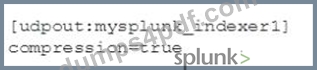
B)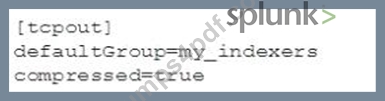
C)
D)
- A. Option A
- B. Option D
- C. Option B
- D. Option C
Answer: C
Explanation:
https://docs.splunk.com/Documentation/Splunk/latest/Admin/Outputsconf
# Compression
#
# This example sends compressed events to the remote indexer.
# NOTE: Compression can be enabled TCP or SSL outputs only.
# The receiver input port should also have compression enabled.
[tcpout]
server = splunkServer.example.com:4433
compressed = true
NEW QUESTION # 42
What is the difference between the two wildcards ... and - for the monitor stanza in inputs, conf?
- A. * matches anything in that specific directory path segment, whereas ... recurses through subdirectories as well.
- B. There is no difference, they are interchangable and match anything beyond directory boundaries.
- C. ... matches anything in that specific directory path segment, whereas - recurses through subdirectories as well.
- D. ... is not supported in monitor stanzas
Answer: A
Explanation:
https://docs.splunk.com/Documentation/Splunk/7.3.0/Data/Specifyinputpathswithwildcards
... The ellipsis wildcard searches recursively through directories and any number of levels of subdirectories to find matches.
If you specify a folder separator (for example, //var/log/.../file), it does not match the first folder level, only subfolders.
* The asterisk wildcard matches anything in that specific folder path segment.
Unlike ..., * does not recurse through subfolders.
NEW QUESTION # 43
What is the default value of LINE_BREAKER?
- A. \r+\n+
- B. \r\n
- C. (\r\n+)
- D. ([\r\n]+)
Answer: D
Explanation:
Reference:
Line breaking, which uses the LINE_BREAKER setting to split the incoming stream of data into separate lines. By default, the LINE_BREAKER value is any sequence of newlines and carriage returns. In regular expression format, this is represented as the following string: ([\r\n]+). You don't normally need to adjust this setting, but in cases where it's necessary, you must configure it in the props.conf configuration file on the forwarder that sends the data to Splunk Cloud Platform or a Splunk Enterprise indexer. The LINE_BREAKER setting expects a value in regular expression format.
NEW QUESTION # 44
Which optional configuration setting in inputs .conf allows you to selectively forward the data to specific indexer(s)?
- A. _TCP_ROUTING
- B. _INDEXER_GROUP
- C. _INDEXER ROUTING
- D. _INDEXER_LIST
Answer: A
NEW QUESTION # 45
Which of the following enables compression for universal forwarders in outputs. conf ?
A)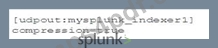
B)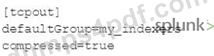
C)
D)
- A. Option A
- B. Option D
- C. Option B
- D. Option C
Answer: C
NEW QUESTION # 46
An organization wants to collect Windows performance data from a set of clients, however, installing Splunk software on these clients is not allowed. What option is available to collect this data in Splunk Enterprise?
- A. Use an index with an Index Data Type of Metrics.
- B. Use Windows Remote Inputs with WMI.
- C. Use Local Windows network monitoring.
- D. Use Local Windows host monitoring.
Answer: B
Explanation:
https://docs.splunk.com/Documentation/Splunk/8.1.0/Data/ConsiderationsfordecidinghowtomonitorWindowsdata
"The Splunk platform collects remote Windows data for indexing in one of two ways: From Splunk forwarders, Using Windows Management Instrumentation (WMI). For Splunk Cloud deployments, you must use the Splunk Universal Forwarder on a Windows machines to montior remote Windows data."
NEW QUESTION # 47
Which of the following are supported options when configuring optional network inputs?
- A. Metadata override, sender filtering options, network input queues (quantum queues)
- B. Metadata override, receiver filtering options, network input queues (memory/persistent queues)
- C. Metadata override, sender filtering options, network input queues (memory/persistent queues)
- D. Filename override, sender filtering options, network output queues (memory/persistent queues)
Answer: B
NEW QUESTION # 48
What is the difference between the two wildcards ...and *for the monitor stanza in inputs.conf?
- A. There is no difference, they are interchangeable and match anything beyond directory boundaries.
- B. ...is not supported in monitor stanzas.
- C. *matches anything in that specific directory path segment, whereas ...recurses through subdirectories as well.
- D. ...matches anything in that specific directory path segment, whereas *recurses through subdirectories as well.
Answer: C
Explanation:
Explanation/Reference: https://docs.splunk.com/Documentation/Splunk/7.3.0/Data/Specifyinputpathswithwildcards
NEW QUESTION # 49
What is the default character encoding used by Splunk during the input phase?
- A. UTF-16
- B. ISO 8859
- C. UTF-8
- D. EBCDIC
Answer: C
Explanation:
Explanation/Reference: https://docs.splunk.com/Documentation/Splunk/7.3.1/Data/Configurecharactersetencoding
NEW QUESTION # 50
......
Latest SPLK-1003 Pass Guaranteed Exam Dumps Certification Sample Questions: https://www.dumps4pdf.com/SPLK-1003-valid-braindumps.html
SPLK-1003 Exam with Guarantee Updated 140 Questions: https://drive.google.com/open?id=1oMHwUj6paofBcf-1Om4J47k7KBuPtljG