


Updated Jan 11, 2022 Certification Exam DP-203 Dumps - Practice Test Questions
Updated Verified DP-203 dumps Q&As - Pass Guarantee or Full Refund
Skills measured
- Monitor and optimize data storage and data processing (10-15%)
- Design and implement data storage (40-45%)
- Design and develop data processing (25-30%)
- Design and implement data security (10-15%)
Schedule exam
Languages: English, Chinese (Simplified), Japanese, Korean
Retirement date: none
This exam measures your ability to accomplish the following technical tasks: design and implement data storage; design and develop data processing; design and implement data security; and monitor and optimize data storage and data processing.
NEW QUESTION 28
You are creating an Azure Data Factory data flow that will ingest data from a CSV file, cast columns to specified types of data, and insert the data into a table in an Azure Synapse Analytic dedicated SQL pool. The CSV file contains three columns named username, comment, and date.
The data flow already contains the following:
* A source transformation.
* A Derived Column transformation to set the appropriate types of data.
* A sink transformation to land the data in the pool.
You need to ensure that the data flow meets the following requirements:
* All valid rows must be written to the destination table.
* Truncation errors in the comment column must be avoided proactively.
* Any rows containing comment values that will cause truncation errors upon insert must be written to a file in blob storage.
Which two actions should you perform? Each correct answer presents part of the solution.
NOTE: Each correct selection is worth one point.
- A. To the data flow, add a filter transformation to filter out rows that will cause truncation errors.
- B. Add a select transformation to select only the rows that will cause truncation errors.
- C. To the data flow, add a sink transformation to write the rows to a file in blob storage.
- D. To the data flow, add a Conditional Split transformation to separate the rows that will cause truncation errors.
Answer: C,D
Explanation:
Explanation
B: Example:
1. This conditional split transformation defines the maximum length of "title" to be five. Any row that is less than or equal to five will go into the GoodRows stream. Any row that is larger than five will go into the BadRows stream.
2. This conditional split transformation defines the maximum length of "title" to be five. Any row that is less than or equal to five will go into the GoodRows stream. Any row that is larger than five will go into the BadRows stream.
A:
3. Now we need to log the rows that failed. Add a sink transformation to the BadRows stream for logging.
Here, we'll "auto-map" all of the fields so that we have logging of the complete transaction record. This is a text-delimited CSV file output to a single file in Blob Storage. We'll call the log file "badrows.csv".
4. The completed data flow is shown below. We are now able to split off error rows to avoid the SQL truncation errors and put those entries into a log file. Meanwhile, successful rows can continue to write to our target database.
Reference:
https://docs.microsoft.com/en-us/azure/data-factory/how-to-data-flow-error-rows
NEW QUESTION 29
You have an Azure Synapse Analytics dedicated SQL pool named Pool1 and a database named DB1. DB1 contains a fact table named Table1.
You need to identify the extent of the data skew in Table1.
What should you do in Synapse Studio?
- A. Connect to the built-in pool and run dbcc pdw_showspaceused.
- B. Connect to Pool1 and query sys.dm_pdw_node_scacus.
- C. Connect to Pool1 and query sys.dm_pdw_nodes_db_partition_scacs.
- D. Connect to the built-in pool and run dbcc checkalloc.
Answer: A
Explanation:
A quick way to check for data skew is to use DBCC PDW_SHOWSPACEUSED. The following SQL code returns the number of table rows that are stored in each of the 60 distributions. For balanced performance, the rows in your distributed table should be spread evenly across all the distributions.
DBCC PDW_SHOWSPACEUSED('dbo.FactInternetSales');
Reference:
https://docs.microsoft.com/en-us/azure/synapse-analytics/sql-data-warehouse/sql-data-warehouse-tables-distribute
NEW QUESTION 30
You have an Azure Synapse Analytics dedicated SQL pool that contains the users shown in the following table.
User1 executes a query on the database, and the query returns the results shown in the following exhibit.
User1 is the only user who has access to the unmasked data.
Use the drop-down menus to select the answer choice that completes each statement based on the information presented in the graphic.
NOTE: Each correct selection is worth one point.
Answer:
Explanation:
Explanation
Graphical user interface, text, application, email Description automatically generated
Box 1: 0
The YearlyIncome column is of the money data type.
The Default masking function: Full masking according to the data types of the designated fields
* Use a zero value for numeric data types (bigint, bit, decimal, int, money, numeric, smallint, smallmoney, tinyint, float, real).
Box 2: the values stored in the database
Users with administrator privileges are always excluded from masking, and see the original data without any mask.
Reference:
https://docs.microsoft.com/en-us/azure/azure-sql/database/dynamic-data-masking-overview
NEW QUESTION 31
You have an Azure SQL database named Database1 and two Azure event hubs named HubA and HubB. The data consumed from each source is shown in the following table.
You need to implement Azure Stream Analytics to calculate the average fare per mile by driver.
How should you configure the Stream Analytics input for each source? To answer, select the appropriate options in the answer area.
NOTE: Each correct selection is worth one point.
Answer:
Explanation:
Explanation
HubA: Stream
HubB: Stream
Database1: Reference
Reference data (also known as a lookup table) is a finite data set that is static or slowly changing in nature, used to perform a lookup or to augment your data streams. For example, in an IoT scenario, you could store metadata about sensors (which don't change often) in reference data and join it with real time IoT data streams. Azure Stream Analytics loads reference data in memory to achieve low latency stream processing Reference:
https://docs.microsoft.com/en-us/azure/stream-analytics/stream-analytics-use-reference-data
NEW QUESTION 32
You have two Azure Storage accounts named Storage1 and Storage2. Each account holds one container and has the hierarchical namespace enabled. The system has files that contain data stored in the Apache Parquet format.
You need to copy folders and files from Storage1 to Storage2 by using a Data Factory copy activity. The solution must meet the following requirements:
* No transformations must be performed.
* The original folder structure must be retained.
* Minimize time required to perform the copy activity.
How should you configure the copy activity? To answer, select the appropriate options in the answer area.
NOTE: Each correct selection is worth one point.
Answer:
Explanation:
Explanation
Graphical user interface, text, application, chat or text message Description automatically generated
Box 1: Parquet
For Parquet datasets, the type property of the copy activity source must be set to ParquetSource.
Box 2: PreserveHierarchy
PreserveHierarchy (default): Preserves the file hierarchy in the target folder. The relative path of the source file to the source folder is identical to the relative path of the target file to the target folder.
Reference:
https://docs.microsoft.com/en-us/azure/data-factory/format-parquet
https://docs.microsoft.com/en-us/azure/data-factory/connector-azure-data-lake-storage
NEW QUESTION 33
You are designing an enterprise data warehouse in Azure Synapse Analytics that will contain a table named Customers. Customers will contain credit card information.
You need to recommend a solution to provide salespeople with the ability to view all the entries in Customers.
The solution must prevent all the salespeople from viewing or inferring the credit card information.
What should you include in the recommendation?
- A. row-level security
- B. Always Encrypted
- C. data masking
- D. column-level security
Answer: C
Explanation:
Explanation
SQL Database dynamic data masking limits sensitive data exposure by masking it to non-privileged users.
The Credit card masking method exposes the last four digits of the designated fields and adds a constant string as a prefix in the form of a credit card.
Example: XXXX-XXXX-XXXX-1234
Reference:
https://docs.microsoft.com/en-us/azure/sql-database/sql-database-dynamic-data-masking-get-started
NEW QUESTION 34
You have a self-hosted integration runtime in Azure Data Factory.
The current status of the integration runtime has the following configurations:
Status: Running
Type: Self-Hosted
Running / Registered Node(s): 1/1
High Availability Enabled: False
Linked Count: 0
Queue Length: 0
Average Queue Duration. 0.00s
The integration runtime has the following node details:
Name: X-M
Status: Running
Available Memory: 7697MB
CPU Utilization: 6%
Network (In/Out): 1.21KBps/0.83KBps
Concurrent Jobs (Running/Limit): 2/14
Role: Dispatcher/Worker
Credential Status: In Sync
Use the drop-down menus to select the answer choice that completes each statement based on the information presented.
NOTE: Each correct selection is worth one point.
Answer:
Explanation:
Reference:
https://docs.microsoft.com/en-us/azure/data-factory/create-self-hosted-integration-runtime
NEW QUESTION 35
You are designing a dimension table for a data warehouse. The table will track the value of the dimension attributes over time and preserve the history of the data by adding new rows as the data changes.
Which type of slowly changing dimension (SCD) should use?
- A. Type 3
- B. Type 0
- C. Type 2
- D. Type 1
Answer: C
Explanation:
Explanation
Type 2 - Creating a new additional record. In this methodology all history of dimension changes is kept in the database. You capture attribute change by adding a new row with a new surrogate key to the dimension table. Both the prior and new rows contain as attributes the natural key(or other durable identifier). Also
'effective date' and 'current indicator' columns are used in this method. There could be only one record with current indicator set to 'Y'. For 'effective date' columns, i.e. start_date and end_date, the end_date for current record usually is set to value 9999-12-31. Introducing changes to the dimensional model in type 2 could be very expensive database operation so it is not recommended to use it in dimensions where a new attribute could be added in the future.
https://www.datawarehouse4u.info/SCD-Slowly-Changing-Dimensions.html
NEW QUESTION 36
You have a table named SalesFact in an enterprise data warehouse in Azure Synapse Analytics. SalesFact contains sales data from the past 36 months and has the following characteristics:
Is partitioned by month
Contains one billion rows
Has clustered columnstore indexes
At the beginning of each month, you need to remove data from SalesFact that is older than 36 months as quickly as possible.
Which three actions should you perform in sequence in a stored procedure? To answer, move the appropriate actions from the list of actions to the answer area and arrange them in the correct order.
Answer:
Explanation:
Reference:
https://docs.microsoft.com/en-us/azure/sql-data-warehouse/sql-data-warehouse-tables-partition
NEW QUESTION 37
You have an Azure Data Lake Storage Gen2 account that contains a JSON file for customers. The file contains two attributes named FirstName and LastName.
You need to copy the data from the JSON file to an Azure Synapse Analytics table by using Azure Databricks. A new column must be created that concatenates the FirstName and LastName values.
You create the following components:
A destination table in Azure Synapse
An Azure Blob storage container
A service principal
Which five actions should you perform in sequence next in is Databricks notebook? To answer, move the appropriate actions from the list of actions to the answer area and arrange them in the correct order.
Answer:
Explanation:
Reference:
https://docs.microsoft.com/en-us/azure/azure-databricks/databricks-extract-load-sql-data-warehouse
NEW QUESTION 38
You are designing an enterprise data warehouse in Azure Synapse Analytics that will contain a table named Customers. Customers will contain credit card information.
You need to recommend a solution to provide salespeople with the ability to view all the entries in Customers.
The solution must prevent all the salespeople from viewing or inferring the credit card information.
What should you include in the recommendation?
- A. row-level security
- B. Always Encrypted
- C. data masking
- D. column-level security
Answer: C
Explanation:
SQL Database dynamic data masking limits sensitive data exposure by masking it to non-privileged users.
The Credit card masking method exposes the last four digits of the designated fields and adds a constant string as a prefix in the form of a credit card.
Example: XXXX-XXXX-XXXX-1234
Reference:
https://docs.microsoft.com/en-us/azure/sql-database/sql-database-dynamic-data-masking-get-started
NEW QUESTION 39
You need to implement an Azure Synapse Analytics database object for storing the sales transactions data.
The solution must meet the sales transaction dataset requirements.
What solution must meet the sales transaction dataset requirements.
What should you do? To answer, select the appropriate options in the answer area.
NOTE: Each correct selection is worth one point.
Answer:
Explanation:
NEW QUESTION 40
Note: This question is part of a series of questions that present the same scenario. Each question in the series contains a unique solution that might meet the stated goals. Some question sets might have more than one correct solution, while others might not have a correct solution.
After you answer a question in this scenario, you will NOT be able to return to it. As a result, these questions will not appear in the review screen.
You have an Azure Storage account that contains 100 GB of files. The files contain text and numerical values. 75% of the rows contain description data that has an average length of 1.1 MB.
You plan to copy the data from the storage account to an Azure SQL data warehouse.
You need to prepare the files to ensure that the data copies quickly.
Solution: You modify the files to ensure that each row is less than 1 MB.
Does this meet the goal?
- A. No
- B. Yes
Answer: B
Explanation:
When exporting data into an ORC File Format, you might get Java out-of-memory errors when there are large text columns. To work around this limitation, export only a subset of the columns.
References:
https://docs.microsoft.com/en-us/azure/sql-data-warehouse/guidance-for-loading-data
NEW QUESTION 41
You use Azure Data Lake Storage Gen2.
You need to ensure that workloads can use filter predicates and column projections to filter data at the time the data is read from disk.
Which two actions should you perform? Each correct answer presents part of the solution.
NOTE: Each correct selection is worth one point.
- A. Register the query acceleration feature.
- B. Reregister the Azure Storage resource provider.
- C. Create a storage policy that is scoped to a container prefix filter.
- D. Reregister the Microsoft Data Lake Store resource provider.
- E. Create a storage policy that is scoped to a container.
Answer: A,B
NEW QUESTION 42
Note: This question is part of a series of questions that present the same scenario. Each question in the series contains a unique solution that might meet the stated goals. Some question sets might have more than one correct solution, while others might not have a correct solution.
After you answer a question in this section, you will NOT be able to return to it. As a result, these questions will not appear in the review screen.
You have an Azure Storage account that contains 100 GB of files. The files contain rows of text and numerical values. 75% of the rows contain description data that has an average length of 1.1 MB.
You plan to copy the data from the storage account to an enterprise data warehouse in Azure Synapse Analytics.
You need to prepare the files to ensure that the data copies quickly.
Solution: You copy the files to a table that has a columnstore index.
Does this meet the goal?
- A. No
- B. Yes
Answer: A
Explanation:
Instead convert the files to compressed delimited text files.
Reference:
https://docs.microsoft.com/en-us/azure/sql-data-warehouse/guidance-for-loading-data
NEW QUESTION 43
You have an Azure Stream Analytics query. The query returns a result set that contains 10,000 distinct values for a column named clusterID.
You monitor the Stream Analytics job and discover high latency.
You need to reduce the latency.
Which two actions should you perform? Each correct answer presents a complete solution.
NOTE: Each correct selection is worth one point.
- A. Add a temporal analytic function.
- B. Scale out the query by using PARTITION BY.
- C. Add a pass-through query.
- D. Increase the number of streaming units.
- E. Convert the query to a reference query.
Answer: B,D
Explanation:
C: Scaling a Stream Analytics job takes advantage of partitions in the input or output. Partitioning lets you divide data into subsets based on a partition key. A process that consumes the data (such as a Streaming Analytics job) can consume and write different partitions in parallel, which increases throughput.
E: Streaming Units (SUs) represents the computing resources that are allocated to execute a Stream Analytics job. The higher the number of SUs, the more CPU and memory resources are allocated for your job. This capacity lets you focus on the query logic and abstracts the need to manage the hardware to run your Stream Analytics job in a timely manner.
References:
https://docs.microsoft.com/en-us/azure/stream-analytics/stream-analytics-parallelization
https://docs.microsoft.com/en-us/azure/stream-analytics/stream-analytics-streaming-unit-consumption
NEW QUESTION 44
You have an Azure subscription that contains the following resources:
* An Azure Active Directory (Azure AD) tenant that contains a security group named Group1.
* An Azure Synapse Analytics SQL pool named Pool1.
You need to control the access of Group1 to specific columns and rows in a table in Pool1 Which Transact-SQL commands should you use? To answer, select the appropriate options in the answer area.
NOTE: Each appropriate options in the answer area.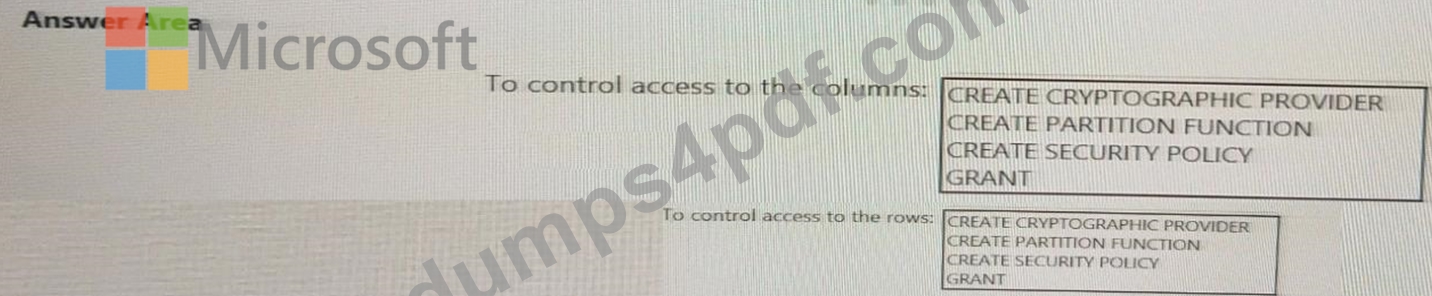
Answer:
Explanation:
NEW QUESTION 45
You are designing an application that will store petabytes of medical imaging data When the data is first created, the data will be accessed frequently during the first week. After one month, the data must be accessible within 30 seconds, but files will be accessed infrequently. After one year, the data will be accessed infrequently but must be accessible within five minutes.
You need to select a storage strategy for the dat
a. The solution must minimize costs.
Which storage tier should you use for each time frame? To answer, select the appropriate options in the answer area.
NOTE: Each correct selection is worth one point.
Answer:
Explanation:
References:
https://docs.microsoft.com/en-us/azure/storage/blobs/storage-blob-storage-tiers
NEW QUESTION 46
You have an enterprise-wide Azure Data Lake Storage Gen2 account. The data lake is accessible only through an Azure virtual network named VNET1.
You are building a SQL pool in Azure Synapse that will use data from the data lake.
Your company has a sales team. All the members of the sales team are in an Azure Active Directory group named Sales. POSIX controls are used to assign the Sales group access to the files in the data lake.
You plan to load data to the SQL pool every hour.
You need to ensure that the SQL pool can load the sales data from the data lake.
Which three actions should you perform? Each correct answer presents part of the solution.
NOTE: Each area selection is worth one point.
- A. Create a managed identity.
- B. Use the snared access signature (SAS) as the credentials for the data load process.
- C. Add the managed identity to the Sales group.
- D. Add your Azure Active Directory (Azure AD) account to the Sales group.
- E. Use the managed identity as the credentials for the data load process.
- F. Create a shared access signature (SAS).
Answer: A,C,D
Explanation:
Explanation
The managed identity grants permissions to the dedicated SQL pools in the workspace.
Note: Managed identity for Azure resources is a feature of Azure Active Directory. The feature provides Azure services with an automatically managed identity in Azure AD Reference:
https://docs.microsoft.com/en-us/azure/synapse-analytics/security/synapse-workspace-managed-identity
NEW QUESTION 47
You need to output files from Azure Data Factory.
Which file format should you use for each type of output? To answer, select the appropriate options in the answer area.
NOTE: Each correct selection is worth one point.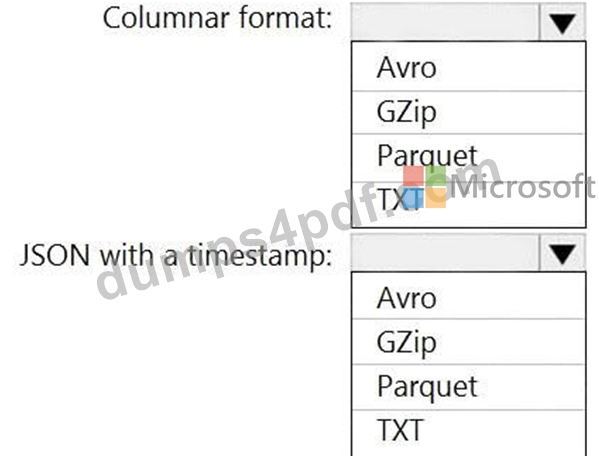
Answer:
Explanation: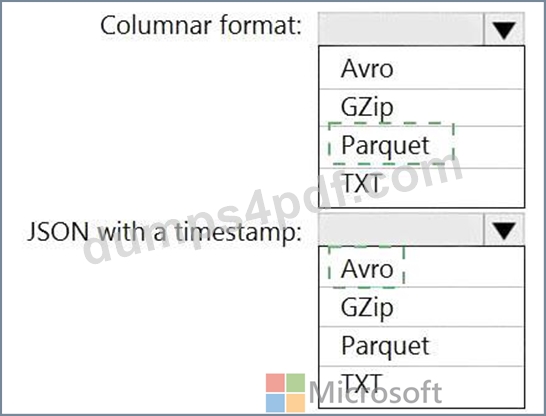
Explanation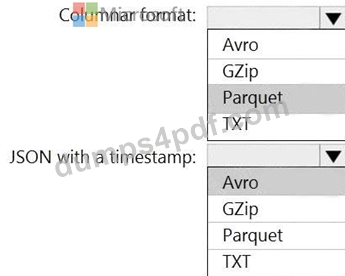
Box 1: Parquet
Parquet stores data in columns, while Avro stores data in a row-based format. By their very nature, column-oriented data stores are optimized for read-heavy analytical workloads, while row-based databases are best for write-heavy transactional workloads.
Box 2: Avro
An Avro schema is created using JSON format.
AVRO supports timestamps.
Note: Azure Data Factory supports the following file formats (not GZip or TXT).
* Avro format
* Binary format
* Delimited text format
* Excel format
* JSON format
* ORC format
* Parquet format
* XML format
Reference:
https://www.datanami.com/2018/05/16/big-data-file-formats-demystified
NEW QUESTION 48
You have an Azure Synapse Analytics dedicated SQL pool named Pool1 and an Azure Data Lake Storage Gen2 account named Account 1.
You plan to access the files in Accoun1l by using an external table.
You need to create a data source in Pool1 that you can reference when you create the external table.
How should you complete the Transact-SQL statement? To answer, select the appropriate options in the answer area.
NOTE Each coned selection is worth one point.
Answer:
Explanation:
See the answer below in explanation.
Explanation
Answer as below
Graphical user interface, text, application Description automatically generated
NEW QUESTION 49
You are designing an Azure Stream Analytics job to process incoming events from sensors in retail environments.
You need to process the events to produce a running average of shopper counts during the previous 15 minutes, calculated at five-minute intervals.
Which type of window should you use?
- A. hopping
- B. tumbling
- C. snapshot
- D. sliding
Answer: B
Explanation:
Explanation
Explanation:
Tumbling windows are a series of fixed-sized, non-overlapping and contiguous time intervals. The following diagram illustrates a stream with a series of events and how they are mapped into 10-second tumbling windows.
Reference:
https://docs.microsoft.com/en-us/stream-analytics-query/tumbling-window-azure-stream-analytics
NEW QUESTION 50
......
Exam Engine for DP-203 Exam Free Demo & 365 Day Updates: https://www.dumps4pdf.com/DP-203-valid-braindumps.html
DP-203 PDF Questions and Testing Engine With 173 Questions: https://drive.google.com/open?id=1oJte9ZD5jn6y7mMfzPEjMvFhJ6ZeY3oG