


Nov-2021 Microsoft DP-203 Actual Questions and Braindumps
DP-203 Dumps To Pass Microsoft Exam in 24 Hours - Dumps4PDF
Microsoft DP-203 Exam Syllabus Topics:
| Topic | Details |
|---|---|
| Topic 1 |
|
| Topic 2 |
|
| Topic 3 |
|
| Topic 4 |
|
| Topic 5 |
|
| Topic 6 |
|
| Topic 7 |
|
| Topic 8 |
|
| Topic 9 |
|
| Topic 10 |
|
| Topic 11 |
|
NEW QUESTION 36
You are processing streaming data from vehicles that pass through a toll booth.
You need to use Azure Stream Analytics to return the license plate, vehicle make, and hour the last vehicle passed during each 10-minute window.
How should you complete the query? To answer, select the appropriate options in the answer area.
NOTE: Each correct selection is worth one point.
Answer:
Explanation:
Explanation
Graphical user interface, text, application Description automatically generated
Box 1: MAX
The first step on the query finds the maximum time stamp in 10-minute windows, that is the time stamp of the last event for that window. The second step joins the results of the first query with the original stream to find the event that match the last time stamps in each window.
Query:
WITH LastInWindow AS
(
SELECT
MAX(Time) AS LastEventTime
FROM
Input TIMESTAMP BY Time
GROUP BY
TumblingWindow(minute, 10)
)
SELECT
Input.License_plate,
Input.Make,
Input.Time
FROM
Input TIMESTAMP BY Time
INNER JOIN LastInWindow
ON DATEDIFF(minute, Input, LastInWindow) BETWEEN 0 AND 10
AND Input.Time = LastInWindow.LastEventTime
Box 2: TumblingWindow
Tumbling windows are a series of fixed-sized, non-overlapping and contiguous time intervals.
Box 3: DATEDIFF
DATEDIFF is a date-specific function that compares and returns the time difference between two DateTime fields, for more information, refer to date functions.
Reference:
https://docs.microsoft.com/en-us/stream-analytics-query/tumbling-window-azure-stream-analytics
NEW QUESTION 37
You have an Azure Stream Analytics job that is a Stream Analytics project solution in Microsoft Visual Studio. The job accepts data generated by IoT devices in the JSON format.
You need to modify the job to accept data generated by the IoT devices in the Protobuf format.
Which three actions should you perform from Visual Studio on sequence? To answer, move the appropriate actions from the list of actions to the answer area and arrange them in the correct order.
Answer:
Explanation:
Reference:
https://docs.microsoft.com/en-us/azure/stream-analytics/custom-deserializer
NEW QUESTION 38
You have a table in an Azure Synapse Analytics dedicated SQL pool. The table was created by using the following Transact-SQL statement.
You need to alter the table to meet the following requirements:
* Ensure that users can identify the current manager of employees.
* Support creating an employee reporting hierarchy for your entire company.
* Provide fast lookup of the managers' attributes such as name and job title.
Which column should you add to the table?
- A. [ManagerEmployeeID] [int] NULL
- B. [ManagerEmployeeID] [smallint] NULL
- C. [ManagerName] [varchar](200) NULL
- D. [ManagerEmployeeKey] [int] NULL
Answer: A
Explanation:
Explanation
Use the same definition as the EmployeeID column.
Reference:
https://docs.microsoft.com/en-us/analysis-services/tabular-models/hierarchies-ssas-tabular
NEW QUESTION 39
You have an Azure Storage account and a data warehouse in Azure Synapse Analytics in the UK South region.
You need to copy blob data from the storage account to the data warehouse by using Azure Data Factory. The solution must meet the following requirements:
* Ensure that the data remains in the UK South region at all times.
* Minimize administrative effort.
Which type of integration runtime should you use?
- A. Self-hosted integration runtime
- B. Azure-SSIS integration runtime
- C. Azure integration runtime
Answer: C
Explanation:
Explanation
Explanation:
Incorrect Answers:
C: Self-hosted integration runtime is to be used On-premises.
Reference:
https://docs.microsoft.com/en-us/azure/data-factory/concepts-integration-runtime
NEW QUESTION 40
You are implementing Azure Stream Analytics windowing functions.
Which windowing function should you use for each requirement? To answer, select the appropriate options in the answer area.
NOTE: Each correct selection is worth one point.
Answer:
Explanation:
NEW QUESTION 41
What should you do to improve high availability of the real-time data processing solution?
- A. Deploy identical Azure Stream Analytics jobs to paired regions in Azure.
- B. Deploy an Azure Stream Analytics job and use an Azure Automation runbook to check the status of the job and to start the job if it stops.
- C. Set Data Lake Storage to use geo-redundant storage (GRS).
- D. Deploy a High Concurrency Databricks cluster.
Answer: A
Explanation:
Guarantee Stream Analytics job reliability during service updates
Part of being a fully managed service is the capability to introduce new service functionality and improvements at a rapid pace. As a result, Stream Analytics can have a service update deploy on a weekly (or more frequent) basis. No matter how much testing is done there is still a risk that an existing, running job may break due to the introduction of a bug. If you are running mission critical jobs, these risks need to be avoided. You can reduce this risk by following Azure's paired region model.
Scenario: The application development team will create an Azure event hub to receive real-time sales data, including store number, date, time, product ID, customer loyalty number, price, and discount amount, from the point of sale (POS) system and output the data to data storage in Azure Reference:
https://docs.microsoft.com/en-us/azure/stream-analytics/stream-analytics-job-reliability Monitor and optimize data storage and data processing Question Set 2
NEW QUESTION 42
You plan to perform batch processing in Azure Databricks once daily.
Which type of Databricks cluster should you use?
- A. interactive
- B. High Concurrency
- C. automated
Answer: C
Explanation:
Azure Databricks has two types of clusters: interactive and automated. You use interactive clusters to analyze data collaboratively with interactive notebooks. You use automated clusters to run fast and robust automated jobs.
Example: Scheduled batch workloads (data engineers running ETL jobs)
This scenario involves running batch job JARs and notebooks on a regular cadence through the Databricks platform.
The suggested best practice is to launch a new cluster for each run of critical jobs. This helps avoid any issues (failures, missing SLA, and so on) due to an existing workload (noisy neighbor) on a shared cluster.
Reference:
https://docs.databricks.com/administration-guide/cloud-configurations/aws/cmbp.html#scenario-3-scheduled-batch-workloads-data-engineers-running-etl-jobs
NEW QUESTION 43
Note: This question is part of a series of questions that present the same scenario. Each question in the series contains a unique solution that might meet the stated goals. Some question sets might have more than one correct solution, while others might not have a correct solution.
After you answer a question in this scenario, you will NOT be able to return to it. As a result, these questions will not appear in the review screen.
You have an Azure Storage account that contains 100 GB of files. The files contain text and numerical values.
75% of the rows contain description data that has an average length of 1.1 MB.
You plan to copy the data from the storage account to an Azure SQL data warehouse.
You need to prepare the files to ensure that the data copies quickly.
Solution: You modify the files to ensure that each row is less than 1 MB.
Does this meet the goal?
- A. No
- B. Yes
Answer: B
Explanation:
Explanation
When exporting data into an ORC File Format, you might get Java out-of-memory errors when there are large text columns. To work around this limitation, export only a subset of the columns.
References:
https://docs.microsoft.com/en-us/azure/sql-data-warehouse/guidance-for-loading-data
NEW QUESTION 44
You have an on-premises data warehouse that includes the following fact tables. Both tables have the following columns: DateKey, ProductKey, RegionKey. There are 120 unique product keys and 65 unique region keys.
Queries that use the data warehouse take a long time to complete.
You plan to migrate the solution to use Azure Synapse Analytics. You need to ensure that the Azure-based solution optimizes query performance and minimizes processing skew.
What should you recommend? To answer, select the appropriate options in the answer area.
NOTE: Each correct selection is worth one point
Answer:
Explanation:
Reference:
https://docs.microsoft.com/en-us/azure/sql-data-warehouse/sql-data-warehouse-tables-distribute
NEW QUESTION 45
You plan to ingest streaming social media data by using Azure Stream Analytics. The data will be stored in files in Azure Data Lake Storage, and then consumed by using Azure Datiabricks and PolyBase in Azure Synapse Analytics.
You need to recommend a Stream Analytics data output format to ensure that the queries from Databricks and PolyBase against the files encounter the fewest possible errors. The solution must ensure that the tiles can be queried quickly and that the data type information is retained.
What should you recommend?
- A. CSV
- B. Avro
- C. JSON
- D. Parquet
Answer: B
Explanation:
The Avro format is great for data and message preservation. Avro schema with its support for evolution is essential for making the data robust for streaming architectures like Kafka, and with the metadata that schema provides, you can reason on the data. Having a schema provides robustness in providing meta-data about the data stored in Avro records which are self- documenting the data. References: http://cloudurable.com/blog/avro/index.html
NEW QUESTION 46
You are designing a monitoring solution for a fleet of 500 vehicles. Each vehicle has a GPS tracking device that sends data to an Azure event hub once per minute.
You have a CSV file in an Azure Data Lake Storage Gen2 container. The file maintains the expected geographical area in which each vehicle should be.
You need to ensure that when a GPS position is outside the expected area, a message is added to another event hub for processing within 30 seconds. The solution must minimize cost.
What should you include in the solution? To answer, select the appropriate options in the answer area.
NOTE: Each correct selection is worth one point.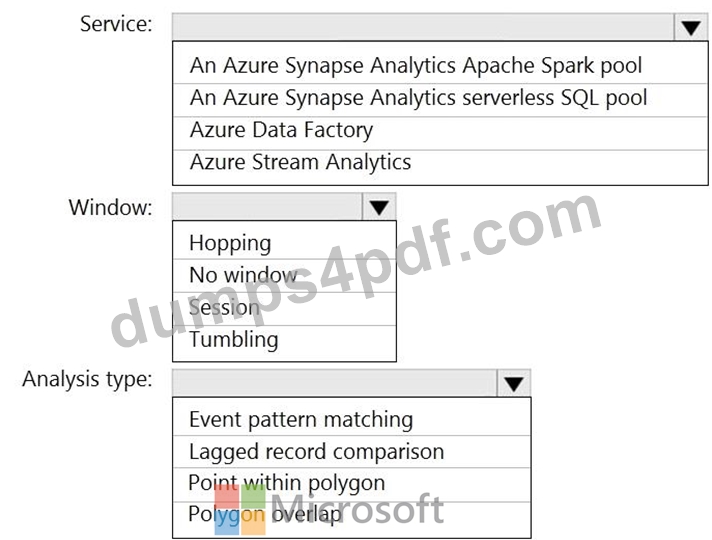
Answer:
Explanation:
Reference:
https://docs.microsoft.com/en-us/azure/stream-analytics/stream-analytics-window-functions
NEW QUESTION 47
You have a data warehouse in Azure Synapse Analytics.
You need to ensure that the data in the data warehouse is encrypted at rest.
What should you enable?
- A. Dynamic Data Masking
- B. Secure transfer required
- C. Transparent Data Encryption (TDE)
- D. Advanced Data Security for this database
Answer: C
Explanation:
Azure SQL Database currently supports encryption at rest for Microsoft-managed service side and client-side encryption scenarios.
Support for server encryption is currently provided through the SQL feature called Transparent Data Encryption.
Client-side encryption of Azure SQL Database data is supported through the Always Encrypted feature.
Reference:
https://docs.microsoft.com/en-us/azure/security/fundamentals/encryption-atrest
NEW QUESTION 48
You have a table in an Azure Synapse Analytics dedicated SQL pool. The table was created by using the following Transact-SQL statement.
You need to alter the table to meet the following requirements:
Ensure that users can identify the current manager of employees.
Support creating an employee reporting hierarchy for your entire company.
Provide fast lookup of the managers' attributes such as name and job title.
Which column should you add to the table?
- A. [ManagerEmployeeID] [int] NULL
- B. [ManagerEmployeeID] [smallint] NULL
- C. [ManagerName] [varchar](200) NULL
- D. [ManagerEmployeeKey] [int] NULL
Answer: A
Explanation:
Use the same definition as the EmployeeID column.
Reference:
https://docs.microsoft.com/en-us/analysis-services/tabular-models/hierarchies-ssas-tabular
NEW QUESTION 49
You have an enterprise data warehouse in Azure Synapse Analytics.
Using PolyBase, you create an external table named [Ext].[Items] to query Parquet files stored in Azure Data Lake Storage Gen2 without importing the data to the data warehouse.
The external table has three columns.
You discover that the Parquet files have a fourth column named ItemID.
Which command should you run to add the ItemID column to the external table?
- A. Option A
- B. Option B
- C. Option C
- D. Option D
Answer: C
Explanation:
Explanation
https://docs.microsoft.com/en-us/sql/t-sql/statements/create-external-table-transact-sql
NEW QUESTION 50
You have the following Azure Stream Analytics query.
For each of the following statements, select Yes if the statement is true. Otherwise, select No.
NOTE: Each correct selection is worth one point.
Answer:
Explanation:
Explanation
Box 1: Yes
You can now use a new extension of Azure Stream Analytics SQL to specify the number of partitions of a stream when reshuffling the data.
The outcome is a stream that has the same partition scheme. Please see below for an example:
WITH step1 AS (SELECT * FROM [input1] PARTITION BY DeviceID INTO 10),
step2 AS (SELECT * FROM [input2] PARTITION BY DeviceID INTO 10)
SELECT * INTO [output] FROM step1 PARTITION BY DeviceID UNION step2 PARTITION BY DeviceID Note: The new extension of Azure Stream Analytics SQL includes a keyword INTO that allows you to specify the number of partitions for a stream when performing reshuffling using a PARTITION BY statement.
Box 2: Yes
When joining two streams of data explicitly repartitioned, these streams must have the same partition key and partition count.
Box 3: Yes
10 partitions x six SUs = 60 SUs is fine.
Note: Remember, Streaming Unit (SU) count, which is the unit of scale for Azure Stream Analytics, must be adjusted so the number of physical resources available to the job can fit the partitioned flow. In general, six SUs is a good number to assign to each partition. In case there are insufficient resources assigned to the job, the system will only apply the repartition if it benefits the job.
Reference:
https://azure.microsoft.com/en-in/blog/maximize-throughput-with-repartitioning-in-azure-stream-analytics/
NEW QUESTION 51
......
Skills measured
- Design and develop data processing (25-30%)
- Design and implement data security (10-15%)
- Monitor and optimize data storage and data processing (10-15%)
- Design and implement data storage (40-45%)
Download the Latest DP-203 Dump - 2021 DP-203 Exam Question Bank: https://www.dumps4pdf.com/DP-203-valid-braindumps.html
Buy Latest DP-203 Exam Q&A PDF - One Year Free Update: https://drive.google.com/open?id=1w5_TAIELOjCJDCTAJqzTY-lrpp5Morqn