


Updated May 07, 2024 Certification Exam Professional-Cloud-Developer Dumps - Practice Test Questions
Updated Verified Professional-Cloud-Developer dumps Q&As - Pass Guarantee or Full Refund
Google Professional-Cloud-Developer exam is designed to test the skills and knowledge of professionals who are developers and architects in the cloud computing industry. Google Certified Professional - Cloud Developer certification is ideal for individuals who are interested in developing cloud-based applications on the Google Cloud Platform. Professional-Cloud-Developer exam is designed to test the candidate's proficiency in programming languages like Java, Python, and Node.js, and their ability to develop, test, and deploy applications on the Google Cloud Platform.
NEW QUESTION # 43
You have an application in production. It is deployed on Compute Engine virtual machine instances controlled by a managed instance group. Traffic is routed to the instances via a HTTP(s) load balancer. Your users are unable to access your application. You want to implement a monitoring technique to alert you when the application is unavailable.
Which technique should you choose?
- A. Smoke tests
- B. Stackdriver uptime checks
- C. Managed instance group - heath checks
- D. Cloud Load Balancing - heath checks
Answer: B
Explanation:
Reference:
476b8507f59c
NEW QUESTION # 44
You are building an API that will be used by Android and iOS apps The API must:
* Support HTTPs
* Minimize bandwidth cost
* Integrate easily with mobile apps
Which API architecture should you use?
- A. SOAP-based APIs
- B. gRPC-based APIs
- C. MQTT for APIs
- D. RESTful APIs
Answer: D
Explanation:
Reference:
https://www.devteam.space/blog/how-to-build-restful-api-for-your-mobile-app/
NEW QUESTION # 45
You plan to make a simple HTML application available on the internet. This site keeps information about FAQs for your application. The application is static and contains images, HTML, CSS, and Javascript. You want to make this application available on the internet with as few steps as possible.
What should you do?
- A. Upload your application to an App Engine environment.
- B. Containerize your application first. Deploy this container to Google Kubernetes Engine (GKE) and assign an external IP address to the GKE pod hosting the application.
- C. Upload your application to Cloud Storage.
- D. Create a Compute Engine instance with Apache web server installed. Configure Apache web server to host the application.
Answer: C
Explanation:
Reference:
https://cloud.google.com/storage/docs/hosting-static-website
NEW QUESTION # 46
You are working on a social media application. You plan to add a feature that allows users to upload images. These images will be 2 MB - 1 GB in size. You want to minimize their infrastructure operations overhead for this feature. What should you do?
- A. Change the application to accept images directly and store them in the database that stores other user information.
- B. Change the application to create signed URLs for Cloud Storage. Transfer these signed URLs to the client application to upload images to Cloud Storage.
- C. Create a separate bucket for each user in Cloud Storage. Assign a separate service account to allow write access on each bucket. Transfer service account credentials to the client application based on user information. The application uses this service account to upload images to Cloud Storage.
- D. Set up a web server on GCP to accept user images and create a file store to keep uploaded files. Change the application to retrieve images from the file store.
Answer: B
Explanation:
Reference:
https://cloud.google.com/blog/products/storage-data-transfer/uploading-images-directly-to-cloud-storage-by-using-signed-url
NEW QUESTION # 47
You are a developer at a large organization Your team uses Git for source code management (SCM). You want to ensure that your team follows Google-recommended best practices to manage code to drive higher rates of software delivery. Which SCM process should your team use?
- A. Each group of developers creates a feature branch from the main branch for their work, commits their changes to their branch, and merges their code into the main branch after the change advisory board approves it.
- B. Each developer creates a branch for their own work, commits their changes to their branch, and merges their code into the main branch daily.
- C. Each group of developers copies the repository, commits their changes to their repository, and merges their code into the main repository before each product release.
- D. Each developer commits their code to the main branch before each product release, conducts testing, and rolls back if integration issues are detected.
Answer: A
Explanation:
Use a centralized repository. A centralized repository is a single location where all of your team's code is stored. This makes it easy for everyone to access the latest code, and it also helps to prevent conflicts. Use branches. Branches are a way to create a separate version of the code for development purposes. This allows developers to work on new features or bug fixes without affecting the main branch of the code.
NEW QUESTION # 48
You are building an API that will be used by Android and iOS apps The API must:
* Support HTTPs
* Minimize bandwidth cost
* Integrate easily with mobile apps
Which API architecture should you use?
- A. SOAP-based APIs
- B. gRPC-based APIs
- C. MQTT for APIs
- D. RESTful APIs
Answer: D
Explanation:
Explanation/Reference: https://www.devteam.space/blog/how-to-build-restful-api-for-your-mobile-app/
NEW QUESTION # 49
Your team develops services that run on Google Kubernetes Engine. Your team's code is stored in Cloud Source Repositories. You need to quickly identify bugs in the code before it is deployed to production. You want to invest in automation to improve developer feedback and make the process as efficient as possible.
What should you do?
- A. Use Spinnaker to automate building container images from code based on Git tags.
- B. Use Cloud Build to automate building container images from code based on Git tags.
- C. Use Spinnaker to automate deploying container images to the production environment.
- D. Use Cloud Build to automate building container images from code based on forked versions.
Answer: A
Explanation:
Reference: https://spinnaker.io/docs/guides/tutorials/codelabs/kubernetes-v2-source-to-prod/
NEW QUESTION # 50
You are developing an event-driven application. You have created a topic to receive messages sent to Pub/Sub. You want those messages to be processed in real time. You need the application to be independent from any other system and only incur compute costs when new messages arrive. You want to configure the simplest and most efficient architecture What should you do?
- A. Deploy the application on Google Kubernetes Engine. Use the Pub/Sub API to create a pull subscription to the Pub/Sub topic and read messages from it
- B. Deploy the application on Compute Engine. Use a Pub/Sub push subscription to process new messages in the topic.
- C. Deploy your code on Cloud Functions. Use a Pub/Sub trigger to invoke the Cloud Function. Use the Pub/Sub API to create a pull subscription to the Pub/Sub topic and read messages from it.
- D. Deploy your code on Cloud Functions. Use a Pub/Sub trigger to handle new messages in the topic.
Answer: D
Explanation:
https://cloud.google.com/functions/docs/calling/pubsub
NEW QUESTION # 51
Your team is building an application for a financial institution. The application's frontend runs on Compute Engine, and the data resides in Cloud SQL and one Cloud Storage bucket. The application will collect data containing PII, which will be stored in the Cloud SQL database and the Cloud Storage bucket. You need to secure the PII data. What should you do?
- A. 1) Configure a private IP address for Cloud SQL
2) Use VPC-SC to create a service perimeter
3) Add the Cloud SQL database and the Cloud Storage bucket to the same service perimeter - B. 1) Create the relevant firewall rules to allow only the frontend to communicate with the Cloud SQL database
2) Using IAM, allow only the frontend service account to access the Cloud Storage bucket - C. 1) Configure a private IP address for Cloud SQL
2) Use VPC-SC to create a service perimeter
3) Add the Cloud SQL database and the Cloud Storage bucket to different service perimeters - D. 1) Create the relevant firewall rules to allow only the frontend to communicate with the Cloud SQL database
2) Enable private access to allow the frontend to access the Cloud Storage bucket privately
Answer: A
NEW QUESTION # 52
Your application is deployed in a Google Kubernetes Engine (GKE) cluster. When a new version of your application is released, your CI/CD tool updates the spec.template.spec.containers[0].image value to reference the Docker image of your new application version. When the Deployment object applies the change, you want to deploy at least 1 replica of the new version and maintain the previous replicas until the new replica is healthy.
Which change should you make to the GKE Deployment object shown below?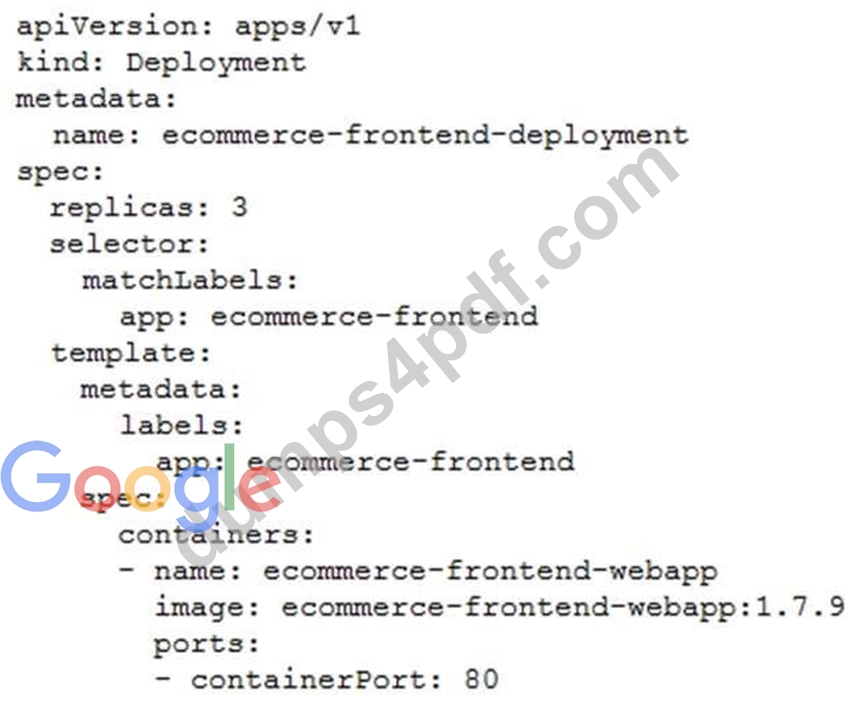
- A. Set the Deployment strategy to Recreate with maxSurge set to 0, maxUnavailable set to 1.
- B. Set the Deployment strategy to RollingUpdate with maxSurge set to 0, maxUnavailable set to 1.
- C. Set the Deployment strategy to Recreate with maxSurge set to 1, maxUnavailable set to 0.
- D. Set the Deployment strategy to RollingUpdate with maxSurge set to 1, maxUnavailable set to 0.
Answer: C
NEW QUESTION # 53
Case study
This is a case study. Case studies are not timed separately. You can use as much exam time as you would like to complete each case. However, there may be additional case studies and sections on this exam. You must manage your time to ensure that you are able to complete all questions included on this exam in the time provided.
To answer the questions included in a case study, you will need to reference information that is provided in the case study. Case studies might contain exhibits and other resources that provide more information about the scenario that is described in the case study. Each question is independent of the other questions in this case study.
At the end of this case study, a review screen will appear. This screen allows you to review your answers and to make changes before you move to the next section of the exam. After you begin a new section, you cannot return to this section.
To start the case study
To display the first question in this case study, click the Next button. Use the buttons in the left pane to explore the content of the case study before you answer the questions. Clicking these buttons displays information such as business requirements, existing environment, and problem statements. If the case study has an All Information tab, note that the information displayed is identical to the information displayed on the subsequent tabs. When you are ready to answer a question, click the Question button to return to the question.
Company Overview
HipLocal is a community application designed to facilitate communication between people in close proximity. It is used for event planning and organizing sporting events, and for businesses to connect with their local communities. HipLocal launched recently in a few neighborhoods in Dallas and is rapidly growing into a global phenomenon. Its unique style of hyper-local community communication and business outreach is in demand around the world.
Executive Statement
We are the number one local community app; it's time to take our local community services global. Our venture capital investors want to see rapid growth and the same great experience for new local and virtual communities that come online, whether their members are 10 or 10000 miles away from each other.
Solution Concept
HipLocal wants to expand their existing service, with updated functionality, in new regions to better serve their global customers. They want to hire and train a new team to support these regions in their time zones. They will need to ensure that the application scales smoothly and provides clear uptime data.
Existing Technical Environment
HipLocal's environment is a mix of on-premises hardware and infrastructure running in Google Cloud Platform.
The HipLocal team understands their application well, but has limited experience in global scale applications.
Their existing technical environment is as follows:
* Existing APIs run on Compute Engine virtual machine instances hosted in GCP.
* State is stored in a single instance MySQL database in GCP.
* Data is exported to an on-premises Teradata/Vertica data warehouse.
* Data analytics is performed in an on-premises Hadoop environment.
* The application has no logging.
* There are basic indicators of uptime; alerts are frequently fired when the APIs are unresponsive.
Business Requirements
HipLocal's investors want to expand their footprint and support the increase in demand they are seeing. Their requirements are:
* Expand availability of the application to new regions.
* Increase the number of concurrent users that can be supported.
* Ensure a consistent experience for users when they travel to different regions.
* Obtain user activity metrics to better understand how to monetize their product.
* Ensure compliance with regulations in the new regions (for example, GDPR).
* Reduce infrastructure management time and cost.
* Adopt the Google-recommended practices for cloud computing.
Technical Requirements
* The application and backend must provide usage metrics and monitoring.
* APIs require strong authentication and authorization.
* Logging must be increased, and data should be stored in a cloud analytics platform.
* Move to serverless architecture to facilitate elastic scaling.
* Provide authorized access to internal apps in a secure manner.
HipLocal's data science team wants to analyze user reviews.
How should they prepare the data?
- A. Use the Cloud Data Loss Prevention API for de-identification of the review dataset.
- B. Use the Cloud Data Loss Prevention API for redaction of the review dataset.
- C. Use the Cloud Natural Language Processing API for redaction of the review dataset.
- D. Use the Cloud Natural Language Processing API for de-identification of the review dataset.
Answer: D
NEW QUESTION # 54
You have an application running on Google Kubernetes Engine (GKE). The application is currently using a logging library and is outputting to standard output You need to export the logs to Cloud Logging, and you need the logs to include metadata about each request. You want to use the simplest method to accomplish this. What should you do?
- A. Change your application s logging library to the Cloud Logging library and configure your application to export logs to Cloud Logging
- B. Update your application to output logs in CSV format, and add the necessary metadata to the CSV.
- C. Install the Fluent Bit agent on each of your GKE nodes, and have the agent export all logs from /var/ log.
- D. Update your application to output logs in JSON format, and add the necessary metadata to the JSON
Answer: B
NEW QUESTION # 55
You have deployed an HTTP(s) Load Balancer with the gcloud commands shown below.
Health checks to port 80 on the Compute Engine virtual machine instance are failing and no traffic is sent to your instances. You want to resolve the problem.
Which commands should you run?
gcloud compute instances add-access-config ${NAME}-backend-instance-1
- A. gcloud compute instances add-tags ${NAME}-backend-instance-1 --tags http-
- B. server
gcloud compute firewall-rules create allow-lb --network load-balancer --allow - C. tcp --source-ranges 130.211.0.0/22,35.191.0.0/16 --direction INGRESS
gcloud compute firewall-rules create allow-lb --network load-balancer --allow - D. tcp --destination-ranges 130.211.0.0/22,35.191.0.0/16 --direction EGRESS
Answer: C
Explanation:
Explanation/Reference: https://cloud.google.com/vpc/docs/special-configurations
NEW QUESTION # 56
Your team detected a spike of errors in an application running on Cloud Run in your production project. The application is configured to read messages from Pub/Sub topic A, process the messages, and write the messages to topic B.
You want to conduct tests to identify the cause of the errors. You can use a set of mock messages for testing. What should you do?
- A. Deploy the Pub/Sub emulator on your local machine. Point the production application to your local Pub/Sub topics. Write mock messages to topic A, and then analyze the logs.
- B. Use the gcloud CLI to write mock messages to topic A. Change the logging level in the application to DEBUG or INFO, and then analyze the logs.
- C. Use the Google Cloud console to write mock messages to topic A. Change the logging level in the application to DEBUG or INFO, and then analyze the logs.
- D. Deploy the Pub/Sub and Cloud Run emulators on your local machine. Deploy the application locally, and change the logging level in the application to DEBUG or INFO. Write mock messages to topic A, and then analyze the logs.
Answer: D
NEW QUESTION # 57
You developed a JavaScript web application that needs to access Google Drive's API and obtain permission from users to store files in their Google Drives. You need to select an authorization approach for your application. What should you do?
- A. Create a SAML token.
- B. Create an API key.
- C. Create an OAuth Client ID.
- D. Create a service account.
Answer: C
NEW QUESTION # 58
You need to deploy resources from your laptop to Google Cloud using Terraform. Resources in your Google Cloud environment must be created using a service account. Your Cloud Identity has the roles/iam.serviceAccountTokenCreator Identity and Access Management (IAM) role and the necessary permissions to deploy the resources using Terraform. You want to set up your development environment to deploy the desired resources following Google-recommended best practices. What should you do?
- A. 1) Run the following command from a command line: gcloud auth application-default login.
2) In the browser window that opens, authenticate using your personal credentials. - B. 1) Run the following command from a command line: gcloud config set auth/impersonate_service_account [email protected].
2) Set the GOOGLE_OAUTH_ACCESS_TOKEN environment variable to the value that is returned by the gcloud auth print-access-token command. - C. 1) Store the service account's key file in JSON format in Hashicorp Vault.
2) Integrate Terraform with Vault to retrieve the key file dynamically, and authenticate to Vault using a short-lived access token. - D. 1) Download the service account's key file in JSON format, and store it locally on your laptop.
2) Set the GOOGLE_APPLICATION_CREDENTIALS environment variable to the path of your downloaded key file.
Answer: C
Explanation:
https://cloud.google.com/iam/docs/best-practices-for-managing-service-account-keys#file-system Whenever possible, avoid storing service account keys on a file system. If you can't avoid storing keys on disk, make sure to restrict access to the key file, configure file access auditing, and encrypt the underlying disk.
https://cloud.google.com/iam/docs/best-practices-for-managing-service-account-keys#software-keystore In situations where using a hardware-based key store isn't viable, use a software-based key store to manage service account keys. Similar to hardware-based options, a software-based key store lets users or applications use service account keys without revealing the private key. Software-based key store solutions can help you control key access in a fine-grained manner and can also ensure that each key access is logged.
NEW QUESTION # 59
Your application takes an input from a user and publishes it to the user's contacts. This input is stored in a table in Cloud Spanner. Your application is more sensitive to latency and less sensitive to consistency.
How should you perform reads from Cloud Spanner for this application?
- A. Perform stale reads using read-write transactions.
- B. Perform strong reads using single-read methods.
- C. Perform stale reads using single-read methods.
- D. Perform Read-Only transactions.
Answer: A
Explanation:
Reference:
https://cloud.google.com/solutions/best-practices-cloud-spanner-gaming-database
NEW QUESTION # 60
You deployed a new application to Google Kubernetes Engine and are experiencing some performance degradation. Your logs are being written to Cloud Logging, and you are using a Prometheus sidecar model for capturing metrics. You need to correlate the metrics and data from the logs to troubleshoot the performance issue and send real-time alerts while minimizing costs. What should you do?
- A. Create custom metrics from the Cloud Logging logs, and use Prometheus to import the results using the Cloud Monitoring REST API.
- B. Export the Prometheus metrics and use Cloud Monitoring to view them as external metrics. Configure Cloud Monitoring to create log-based metrics from the logs, and correlate them with the Prometheus data.
- C. Export the Cloud Logging logs and stream the Prometheus metrics to BigQuery. Run a recurring query to join the results, and send notifications using Cloud Tasks.
- D. Export the Cloud Logging logs and the Prometheus metrics to Cloud Bigtable. Run a query to join the results, and analyze in Google Data Studio.
Answer: B
Explanation:
Reference:
https://cloud.google.com/blog/products/operations/troubleshoot-gke-faster-with-monitoring-data-in-your-logs
NEW QUESTION # 61
......
Career Opportunity
Those individuals who have the Google Professional Cloud Developer certification can take up the job titles, such as Software Engineers, Solutions Architects, Operations Analysts, Web Application Developers, Senior Software Engineers, Information Security Managers, or Data Engineers. The average salary for these positions is $87,000 per annum.
Exam Engine for Professional-Cloud-Developer Exam Free Demo & 365 Day Updates: https://www.dumps4pdf.com/Professional-Cloud-Developer-valid-braindumps.html
Professional-Cloud-Developer PDF Questions and Testing Engine With 256 Questions: https://drive.google.com/open?id=1U7rMnhR9hwfNi50LohZAui1IAifkOLw2