


100% Passing Guarantee - Brilliant Professional-Machine-Learning-Engineer Exam Questions PDF [Jan-2022]
Professional-Machine-Learning-Engineer Dumps 2022 - NewGoogle Professional-Machine-Learning-Engineer Exam Questions
Google Professional-Machine-Learning-Engineer Exam Syllabus Topics:
| Topic | Details |
|---|---|
| Topic 1 |
|
| Topic 2 |
|
| Topic 3 |
|
| Topic 4 |
|
| Topic 5 |
|
| Topic 6 |
|
| Topic 7 |
|
| Topic 8 |
|
Understanding functional and technical aspects of Professional Machine Learning Engineer - Google ML Pipeline Automation & Orchestration
The following will be discussed in Google Professional-Machine-Learning-Engineer dumps:
Design pipeline. Considerations include:
- Use CI/CD to test and deploy models
- Track and audit metadata
- Organization and tracking experiments and pipeline runs
- Model binary options
- Implement training pipeline
- Google Cloud serving options
- Hybrid or multi-cloud strategies
- Storing data and generated artifacts
- Hooking into model and dataset versioning
- Decoupling components with Cloud Build
- Performing data validation
- Implement serving pipeline
- Orchestration framework
Understanding functional and technical aspects of Professional Machine Learning Engineer - Google Data Preparation and Processing
The following will be discussed in Google Professional-Machine-Learning-Engineer dumps:
- Data privacy and compliance
- Ingestion of various file types (e.g. Csv, json, img, parquet or databases, Hadoop/Spark)
- Statistical fundamentals at scale
- Data leakage and augmentation
- Data validation
- Monitoring/changing deployed pipelines
- Class imbalance
- Streaming data (e.g. from IoT devices)
- Build data pipelines
- Design data pipelines
- Evaluation of data quality and feasibility
- Data ingestion
- Database migration
- Feature crosses
- Encoding structured data types
NEW QUESTION 39
Your organization's call center has asked you to develop a model that analyzes customer sentiments in each call. The call center receives over one million calls daily, and data is stored in Cloud Storage. The data collected must not leave the region in which the call originated, and no Personally Identifiable Information (Pll) can be stored or analyzed. The data science team has a third-party tool for visualization and access which requires a SQL ANSI-2011 compliant interface. You need to select components for data processing and for analytics. How should the data pipeline be designed?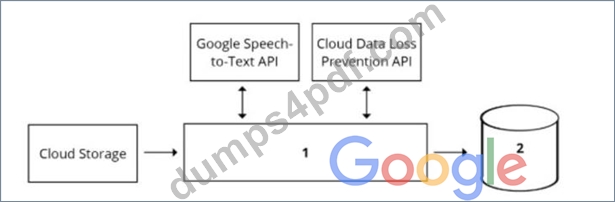
- A. 1 = Cloud Function, 2 = Cloud SQL
- B. 1 = Pub/Sub, 2 = Datastore
- C. 1 = Dataflow, 2 = Cloud SQL
- D. 1 = Dataflow, 2 = BigQuery
Answer: A
NEW QUESTION 40
You are an ML engineer at a large grocery retailer with stores in multiple regions. You have been asked to create an inventory prediction model. Your models features include region, location, historical demand, and seasonal popularity. You want the algorithm to learn from new inventory data on a daily basis. Which algorithms should you use to build the model?
- A. Reinforcement Learning
- B. Convolutional Neural Networks (CNN)
- C. Recurrent Neural Networks (RNN)
- D. Classification
Answer: A
NEW QUESTION 41
You trained a text classification model. You have the following SignatureDefs: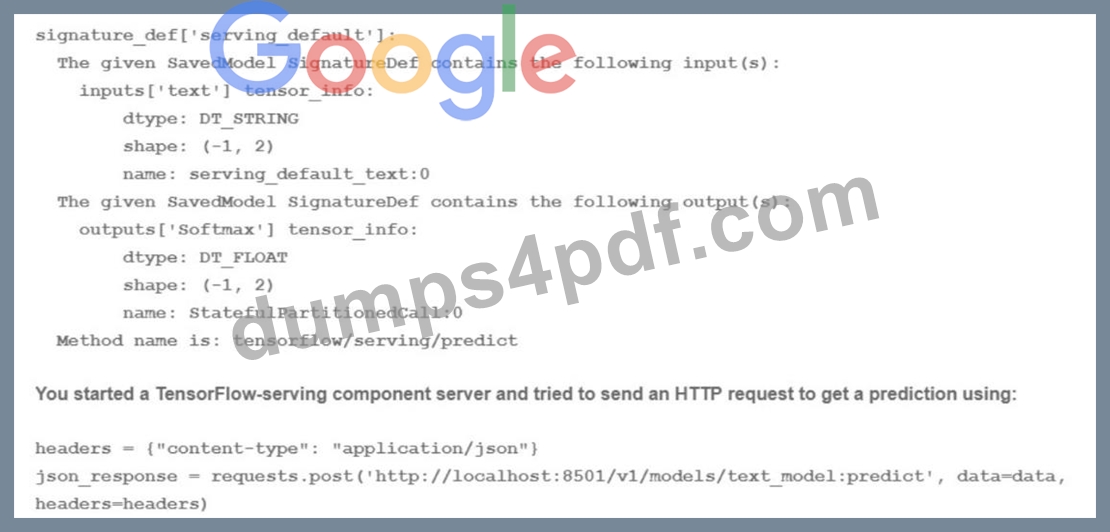
What is the correct way to write the predict request?
- A. data = json dumps({"signature_name": "serving_default"! "instances": [['a', 'b', "c", 'd', 'e', 'f']]})
- B. data = json.dumps({"signature_name": "serving_default'\ "instances": [fab', 'be1, 'cd']]})
- C. data = json dumps({"signature_name": f,serving_default", "instances": [['a', 'b'], [c\ 'd'], ['e\ T]]})
- D. data = json.dumps({"signature_name": "serving_default, "instances": [['a', 'b\ 'c'1, [d\ 'e\ T]]})
Answer: A
NEW QUESTION 42
You have written unit tests for a Kubeflow Pipeline that require custom libraries. You want to automate the execution of unit tests with each new push to your development branch in Cloud Source Repositories. What should you do?
- A. Set up a Cloud Logging sink to a Pub/Sub topic that captures interactions with Cloud Source Repositories. Execute the unit tests using a Cloud Function that is triggered when messages are sent to the Pub/Sub topic
- B. Set up a Cloud Logging sink to a Pub/Sub topic that captures interactions with Cloud Source Repositories Configure a Pub/Sub trigger for Cloud Run, and execute the unit tests on Cloud Run.
- C. Using Cloud Build, set an automated trigger to execute the unit tests when changes are pushed to your development branch.
- D. Write a script that sequentially performs the push to your development branch and executes the unit tests on Cloud Run
Answer: C
NEW QUESTION 43
A Machine Learning Specialist is designing a system for improving sales for a company. The objective is to use the large amount of information the company has on users' behavior and product preferences to predict which products users would like based on the users' similarity to other users.
What should the Specialist do to meet this objective?
- A. Build a model-based filtering recommendation engine with Apache Spark ML on Amazon EMR
- B. Build a combinative filtering recommendation engine with Apache Spark ML on Amazon EMR
- C. Build a collaborative filtering recommendation engine with Apache Spark ML on Amazon EMR.
- D. Build a content-based filtering recommendation engine with Apache Spark ML on Amazon EMR
Answer: C
Explanation:
Many developers want to implement the famous Amazon model that was used to power the "People who bought this also bought these items" feature on Amazon.com. This model is based on a method called Collaborative Filtering. It takes items such as movies, books, and products that were rated highly by a set of users and recommending them to other users who also gave them high ratings. This method works well in domains where explicit ratings or implicit user actions can be gathered and analyzed.
Reference: https://aws.amazon.com/blogs/big-data/building-a-recommendation-engine-with-spark-ml-on-amazon-emr-using-zeppelin/
NEW QUESTION 44
You have a demand forecasting pipeline in production that uses Dataflow to preprocess raw data prior to model training and prediction. During preprocessing, you employ Z-score normalization on data stored in BigQuery and write it back to BigQuery. New training data is added every week. You want to make the process more efficient by minimizing computation time and manual intervention. What should you do?
- A. Normalize the data with Apache Spark using the Dataproc connector for BigQuery
- B. Normalize the data using Google Kubernetes Engine
- C. Use the normalizer_fn argument in TensorFlow's Feature Column API
- D. Translate the normalization algorithm into SQL for use with BigQuery
Answer: D
NEW QUESTION 45
A company wants to classify user behavior as either fraudulent or normal. Based on internal research, a Machine Learning Specialist would like to build a binary classifier based on two features: age of account and transaction month. The class distribution for these features is illustrated in the figure provided.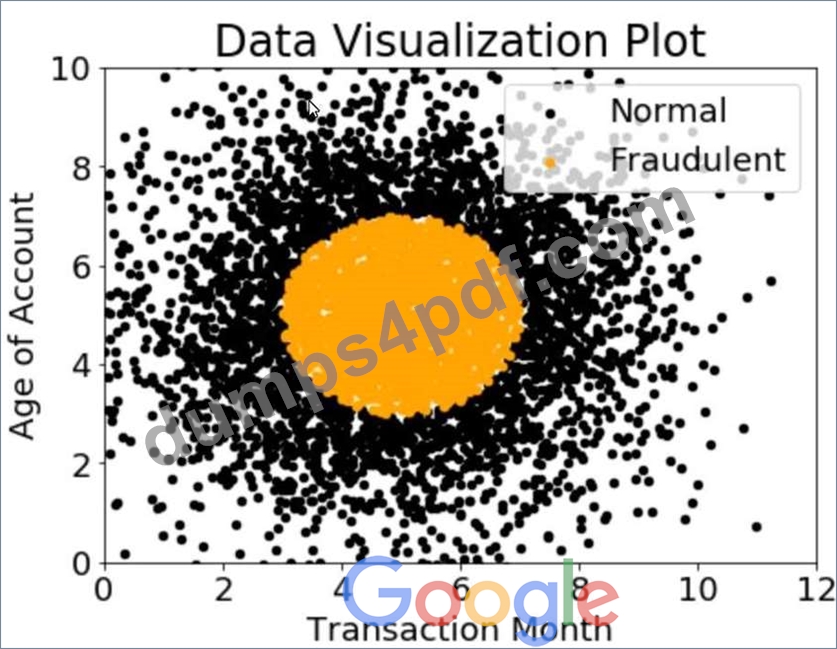
Based on this information, which model would have the HIGHEST accuracy?
- A. Single perceptron with tanh activation function
- B. Logistic regression
- C. Support vector machine (SVM) with non-linear kernel
- D. Long short-term memory (LSTM) model with scaled exponential linear unit (SELU)
Answer: C
NEW QUESTION 46
You are designing an ML recommendation model for shoppers on your company's ecommerce website. You will use Recommendations Al to build, test, and deploy your system. How should you develop recommendations that increase revenue while following best practices?
- A. Use the "Frequently Bought Together' recommendation type to increase the shopping cart size for each order.
- B. Import your user events and then your product catalog to make sure you have the highest quality event stream
- C. Use the "Other Products You May Like" recommendation type to increase the click-through rate
- D. Because it will take time to collect and record product data, use placeholder values for the product catalog to test the viability of the model.
Answer: A
Explanation:
Frequently bought together' recommendations aim to up-sell and cross-sell customers by providing product.
NEW QUESTION 47
During batch training of a neural network, you notice that there is an oscillation in the loss. How should you adjust your model to ensure that it converges?
- A. Increase the size of the training batch
- B. Decrease the learning rate hyperparameter
- C. Increase the learning rate hyperparameter
- D. Decrease the size of the training batch
Answer: C
NEW QUESTION 48
You were asked to investigate failures of a production line component based on sensor readings. After receiving the dataset, you discover that less than 1% of the readings are positive examples representing failure incidents. You have tried to train several classification models, but none of them converge. How should you resolve the class imbalance problem?
- A. Use the class distribution to generate 10% positive examples
- B. Remove negative examples until the numbers of positive and negative examples are equal
- C. Downsample the data with upweighting to create a sample with 10% positive examples
- D. Use a convolutional neural network with max pooling and softmax activation
Answer: B
NEW QUESTION 49
A Machine Learning Specialist trained a regression model, but the first iteration needs optimizing. The Specialist needs to understand whether the model is more frequently overestimating or underestimating the target.
What option can the Specialist use to determine whether it is overestimating or underestimating the target value?
- A. Root Mean Square Error (RMSE)
- B. Area under the curve
- C. Residual plots
- D. Confusion matrix
Answer: B
NEW QUESTION 50
A Machine Learning Specialist is developing a daily ETL workflow containing multiple ETL jobs. The workflow consists of the following processes:
* Start the workflow as soon as data is uploaded to Amazon S3.
* When all the datasets are available in Amazon S3, start an ETL job to join the uploaded datasets with multiple terabyte-sized datasets already stored in Amazon S3.
* Store the results of joining datasets in Amazon S3.
* If one of the jobs fails, send a notification to the Administrator.
Which configuration will meet these requirements?
- A. Use AWS Lambda to chain other Lambda functions to read and join the datasets in Amazon S3 as soon as the data is uploaded to Amazon S3. Use an Amazon CloudWatch alarm to send an SNS notification to the Administrator in the case of a failure.
- B. Develop the ETL workflow using AWS Batch to trigger the start of ETL jobs when data is uploaded to Amazon S3. Use AWS Glue to join the datasets in Amazon S3. Use an Amazon CloudWatch alarm to send an SNS notification to the Administrator in the case of a failure.
- C. Use AWS Lambda to trigger an AWS Step Functions workflow to wait for dataset uploads to complete in Amazon S3. Use AWS Glue to join the datasets. Use an Amazon CloudWatch alarm to send an SNS notification to the Administrator in the case of a failure.
- D. Develop the ETL workflow using AWS Lambda to start an Amazon SageMaker notebook instance. Use a lifecycle configuration script to join the datasets and persist the results in Amazon S3. Use an Amazon CloudWatch alarm to send an SNS notification to the Administrator in the case of a failure.
Answer: C
Explanation:
Explanation/Reference: https://aws.amazon.com/step-functions/use-cases/
NEW QUESTION 51
You have deployed multiple versions of an image classification model on Al Platform. You want to monitor the performance of the model versions overtime. How should you perform this comparison?
- A. Compare the receiver operating characteristic (ROC) curve for each model using the What-lf Tool
- B. Compare the loss performance for each model on the validation data
- C. Compare the mean average precision across the models using the Continuous Evaluation feature
- D. Compare the loss performance for each model on a held-out dataset.
Answer: B
NEW QUESTION 52
You developed an ML model with Al Platform, and you want to move it to production. You serve a few thousand queries per second and are experiencing latency issues. Incoming requests are served by a load balancer that distributes them across multiple Kubeflow CPU-only pods running on Google Kubernetes Engine (GKE). Your goal is to improve the serving latency without changing the underlying infrastructure. What should you do?
- A. Recompile TensorFlow Serving using the source to support CPU-specific optimizations Instruct GKE to choose an appropriate baseline minimum CPU platform for serving nodes
- B. Significantly increase the max_enqueued_batches TensorFlow Serving parameter
- C. Switch to the tensorflow-model-server-universal version of TensorFlow Serving
- D. Significantly increase the max_batch_size TensorFlow Serving parameter
Answer: A
NEW QUESTION 53
A Machine Learning Specialist is given a structured dataset on the shopping habits of a company's customer base. The dataset contains thousands of columns of data and hundreds of numerical columns for each customer. The Specialist wants to identify whether there are natural groupings for these columns across all customers and visualize the results as quickly as possible.
What approach should the Specialist take to accomplish these tasks?
- A. Run k-means using the Euclidean distance measure for different values of k and create an elbow plot.
- B. Embed the numerical features using the t-distributed stochastic neighbor embedding (t-SNE) algorithm and create a scatter plot.
- C. Run k-means using the Euclidean distance measure for different values of k and create box plots for each numerical column within each cluster.
- D. Embed the numerical features using the t-distributed stochastic neighbor embedding (t-SNE) algorithm and create a line graph.
Answer: A
NEW QUESTION 54
You work on a growing team of more than 50 data scientists who all use Al Platform. You are designing a strategy to organize your jobs, models, and versions in a clean and scalable way. Which strategy should you choose?
- A. Use labels to organize resources into descriptive categories. Apply a label to each created resource so that users can filter the results by label when viewing or monitoring the resources
- B. Separate each data scientist's work into a different project to ensure that the jobs, models, and versions created by each data scientist are accessible only to that user.
- C. Set up restrictive I AM permissions on the Al Platform notebooks so that only a single user or group can access a given instance.
- D. Set up a BigQuery sink for Cloud Logging logs that is appropriately filtered to capture information about Al Platform resource usage In BigQuery create a SQL view that maps users to the resources they are using.
Answer: B
NEW QUESTION 55
A Machine Learning Specialist at a company sensitive to security is preparing a dataset for model training. The dataset is stored in Amazon S3 and contains Personally Identifiable Information (PII).
The dataset:
* Must be accessible from a VPC only.
* Must not traverse the public internet.
How can these requirements be satisfied?
- A. Create a VPC endpoint and use Network Access Control Lists (NACLs) to allow traffic between only the given VPC endpoint and an Amazon EC2 instance.
- B. Create a VPC endpoint and apply a bucket access policy that restricts access to the given VPC endpoint and the VPC.
- C. Create a VPC endpoint and use security groups to restrict access to the given VPC endpoint and an Amazon EC2 instance
- D. Create a VPC endpoint and apply a bucket access policy that allows access from the given VPC endpoint and an Amazon EC2 instance.
Answer: D
Explanation:
Explanation/Reference: https://docs.aws.amazon.com/AmazonS3/latest/dev/example-bucket-policies-vpc-endpoint.html
NEW QUESTION 56
A Machine Learning Specialist is developing a custom video recommendation model for an application. The dataset used to train this model is very large with millions of data points and is hosted in an Amazon S3 bucket.
The Specialist wants to avoid loading all of this data onto an Amazon SageMaker notebook instance because it would take hours to move and will exceed the attached 5 GB Amazon EBS volume on the notebook instance.
Which approach allows the Specialist to use all the data to train the model?
- A. Use AWS Glue to train a model using a small subset of the data to confirm that the data will be compatible with Amazon SageMaker. Initiate a SageMaker training job using the full dataset from the S3 bucket using Pipe input mode.
- B. Load a smaller subset of the data into the SageMaker notebook and train locally. Confirm that the training code is executing and the model parameters seem reasonable. Initiate a SageMaker training job using the full dataset from the S3 bucket using Pipe input mode.
- C. Launch an Amazon EC2 instance with an AWS Deep Learning AMI and attach the S3 bucket to the instance. Train on a small amount of the data to verify the training code and hyperparameters. Go back to Amazon SageMaker and train using the full dataset
- D. Load a smaller subset of the data into the SageMaker notebook and train locally. Confirm that the training code is executing and the model parameters seem reasonable. Launch an Amazon EC2 instance with an AWS Deep Learning AMI and attach the S3 bucket to train the full dataset.
Answer: B
NEW QUESTION 57
A company uses a long short-term memory (LSTM) model to evaluate the risk factors of a particular energy sector. The model reviews multi-page text documents to analyze each sentence of the text and categorize it as either a potential risk or no risk. The model is not performing well, even though the Data Scientist has experimented with many different network structures and tuned the corresponding hyperparameters.
Which approach will provide the MAXIMUM performance boost?
- A. Initialize the words by word2vec embeddings pretrained on a large collection of news articles related to the energy sector.
- B. Reduce the learning rate and run the training process until the training loss stops decreasing.
- C. Initialize the words by term frequency-inverse document frequency (TF-IDF) vectors pretrained on a large collection of news articles related to the energy sector.
- D. Use gated recurrent units (GRUs) instead of LSTM and run the training process until the validation loss stops decreasing.
Answer: B
NEW QUESTION 58
You need to design a customized deep neural network in Keras that will predict customer purchases based on their purchase history. You want to explore model performance using multiple model architectures, store training data, and be able to compare the evaluation metrics in the same dashboard. What should you do?
- A. Create an experiment in Kubeflow Pipelines to organize multiple runs
- B. Run multiple training jobs on Al Platform with similar job names
- C. Create multiple models using AutoML Tables
- D. Automate multiple training runs using Cloud Composer
Answer: B
NEW QUESTION 59
You want to rebuild your ML pipeline for structured data on Google Cloud. You are using PySpark to conduct data transformations at scale, but your pipelines are taking over 12 hours to run. To speed up development and pipeline run time, you want to use a serverless tool and SQL syntax. You have already moved your raw data into Cloud Storage. How should you build the pipeline on Google Cloud while meeting the speed and processing requirements?
- A. Use Data Fusion's GUI to build the transformation pipelines, and then write the data into BigQuery
- B. Ingest your data into BigQuery using BigQuery Load, convert your PySpark commands into BigQuery SQL queries to transform the data, and then write the transformations to a new table
- C. Ingest your data into Cloud SQL convert your PySpark commands into SQL queries to transform the data, and then use federated queries from BigQuery for machine learning
- D. Convert your PySpark into SparkSQL queries to transform the data and then run your pipeline on Dataproc to write the data into BigQuery.
Answer: D
NEW QUESTION 60
You are training an LSTM-based model on Al Platform to summarize text using the following job submission script: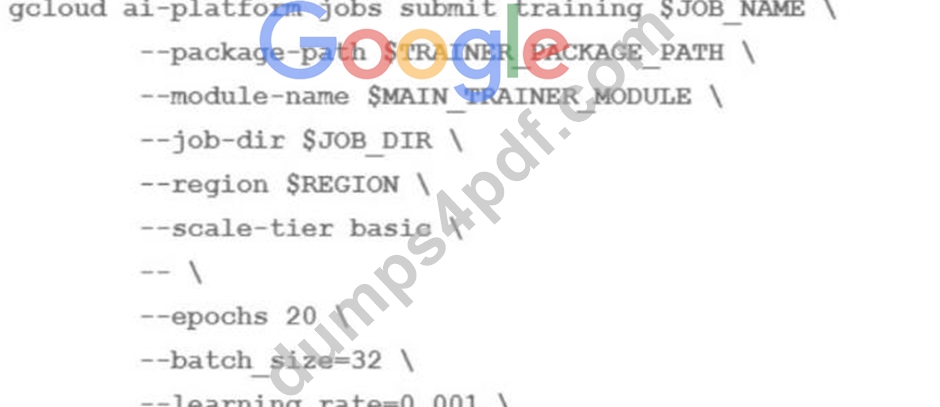
You want to ensure that training time is minimized without significantly compromising the accuracy of your model. What should you do?
- A. Modify the batch size' parameter
- B. Modify the 'learning rate' parameter
- C. Modify the 'epochs' parameter
- D. Modify the 'scale-tier' parameter
Answer: C
NEW QUESTION 61
You are training a TensorFlow model on a structured data set with 100 billion records stored in several CSV files. You need to improve the input/output execution performance. What should you do?
- A. Convert the CSV files into shards of TFRecords, and store the data in Cloud Storage
- B. Load the data into Cloud Bigtable, and read the data from Bigtable
- C. Convert the CSV files into shards of TFRecords, and store the data in the Hadoop Distributed File System (HDFS)
- D. Load the data into BigQuery and read the data from BigQuery.
Answer: B
NEW QUESTION 62
You need to train a computer vision model that predicts the type of government ID present in a given image using a GPU-powered virtual machine on Compute Engine. You use the following parameters:
* Optimizer: SGD
* Image shape = 224x224
* Batch size = 64
* Epochs = 10
* Verbose = 2
During training you encounter the following error: ResourceExhaustedError: out of Memory (oom) when allocating tensor. What should you do?
- A. Reduce the image shape
- B. Change the learning rate
- C. Reduce the batch size
- D. Change the optimizer
Answer: D
NEW QUESTION 63
Your team is building an application for a global bank that will be used by millions of customers. You built a forecasting model that predicts customers1 account balances 3 days in the future. Your team will use the results in a new feature that will notify users when their account balance is likely to drop below $25. How should you serve your predictions?
- A. 1 Build a notification system on Firebase
2. Register each user with a user ID on the Firebase Cloud Messaging server, which sends a notification when your model predicts that a user's account balance will drop below the $25 threshold - B. 1. Create a Pub/Sub topic for each user
2. Deploy an application on the App Engine standard environment that sends a notification when your model predicts that a user's account balance will drop below the $25 threshold - C. 1. Build a notification system on Firebase
2. Register each user with a user ID on the Firebase Cloud Messaging server, which sends a notification when the average of all account balance predictions drops below the $25 threshold - D. 1. Create a Pub/Sub topic for each user
2 Deploy a Cloud Function that sends a notification when your model predicts that a user's account balance will drop below the $25 threshold.
Answer: B
NEW QUESTION 64
......
Free Professional-Machine-Learning-Engineer braindumps download: https://www.dumps4pdf.com/Professional-Machine-Learning-Engineer-valid-braindumps.html
Professional-Machine-Learning-Engineer Dumps for Pass Guaranteed - Pass Professional-Machine-Learning-Engineer Exam: https://drive.google.com/open?id=1DDMCa5xyizZU3O4MlrB6E1M9LHaFcTf-