


Real Microsoft DP-300 Exam Questions [Updated 2021]
DP-300 Exam Dumps Pass with Updated 2021 Administering Relational Databases on Microsoft Azure
NEW QUESTION 19
HOTSPOT
You have an Azure SQL database named DB1 that contains two tables named Table1 and Table2. Both tables
contain a column named a Column1. Column1 is used for joins by an application named App1.
You need to protect the contents of Column1 at rest, in transit, and in use.
How should you protect the contents of Column1? To answer, select the appropriate options in the answer
area.
NOTE: Each correct selection is worth one point.
Hot Area: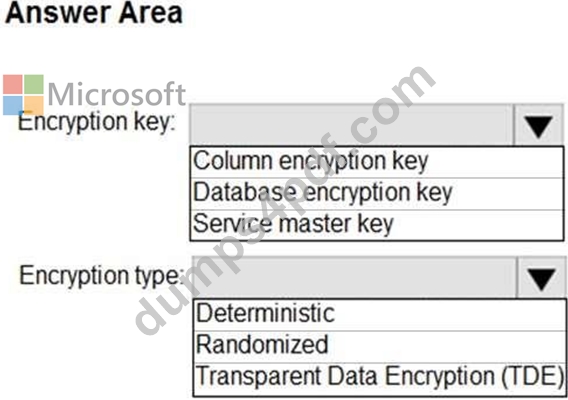
Answer:
Explanation:
Section: [none]
Explanation:
Box 1: Column encryption Key
Always Encrypted uses two types of keys: column encryption keys and column master keys. A column
encryption key is used to encrypt data in an encrypted column. A column master key is a key-protecting key
that encrypts one or more column encryption keys.
Incorrect Answers:
TDE encrypts the storage of an entire database by using a symmetric key called the Database Encryption Key
(DEK).
Box 2: Deterministic
Always Encrypted is a feature designed to protect sensitive data, such as credit card numbers or national
identification numbers (for example, U.S. social security numbers), stored in Azure SQL Database or SQL
Server databases. Always Encrypted allows clients to encrypt sensitive data inside client applications and never
reveal the encryption keys to the Database Engine (SQL Database or SQL Server).
Always Encrypted supports two types of encryption: randomized encryption and deterministic encryption.
Deterministic encryption always generates the same encrypted value for any given plain text value. Using
deterministic encryption allows point lookups, equality joins, grouping and indexing on encrypted columns.
Incorrect Answers:
* Randomized encryption uses a method that encrypts data in a less predictable manner. Randomized
encryption is more secure, but prevents searching, grouping, indexing, and joining on encrypted columns.
* Transparent data encryption (TDE) helps protect Azure SQL Database, Azure SQL Managed Instance, and
Azure Synapse Analytics against the threat of malicious offline activity by encrypting data at rest. It performs
real-time encryption and decryption of the database, associated backups, and transaction log files at rest
without requiring changes to the application.
Reference:
https://docs.microsoft.com/en-us/sql/relational-databases/security/encryption/always-encrypted-database-
engine
NEW QUESTION 20
You have SQL Server on an Azure virtual machine.
You review the query plan shown in the following exhibit.
For each of the following statements, select yes if the statement is true. Otherwise, select no.
NOTE: Each correct selection is worth one point.
Answer:
Explanation:
Reference:
https://docs.microsoft.com/en-us/sql/relational-databases/performance/monitoring-performance-by-using-the-query-store
NEW QUESTION 21
DRAG DROP
You have a resource group named App1Dev that contains an Azure SQL Database server named DevServer1.
DevServer1 contains an Azure SQL database named DB1. The schema and permissions for DB1 are saved in
a Microsoft SQL Server Data Tools (SSDT) database project.
You need to populate a new resource group named App1Test with the DB1 database and an Azure SQL Server
named TestServer1. The resources in App1Test must have the same configurations as the resources in
App1Dev.
Which four actions should you perform in sequence? To answer, move the appropriate actions from the list of
actions to the answer area and arrange them in the correct order.
Select and Place:
Answer:
Explanation:
Section: [none]
NEW QUESTION 22
You need to recommend an availability strategy for an Azure SQL database. The strategy must meet the following requirements:
* Support failovers that do not require client applications to change their connection strings.
* Replicate the database to a secondary Azure region.
* Support failover to the secondary region.
What should you include in the recommendation?
- A. failover groups
- B. transactional replication
- C. Availability Zones
- D. geo-replication
Answer: D
Explanation:
Section: [none]
Explanation:
Active geo-replication is an Azure SQL Database feature that allows you to create readable secondary databases of individual databases on a server in the same or different data center (region).
Incorrect Answers:
C: Availability Zones are unique physical locations within a region. Each zone is made up of one or more datacenters equipped with independent power, cooling, and networking.
Reference:
https://docs.microsoft.com/en-us/azure/azure-sql/database/active-geo-replication-overview
NEW QUESTION 23
Note: This question is part of a series of questions that present the same scenario. Each question in the series contains a unique solution that might meet the stated goals. Some question sets might have more than one correct solution, while others might not have a correct solution.
After you answer a question in this section, you will NOT be able to return to it. As a result, these questions will not appear in the review screen.
You have an Azure Data Lake Storage account that contains a staging zone.
You need to design a daily process to ingest incremental data from the staging zone, transform the data by executing an R script, and then insert the transformed data into a data warehouse in Azure Synapse Analytics.
Solution: You schedule an Azure Databricks job that executes an R notebook, and then inserts the data into the data warehouse.
Does this meet the goal?
- A. No
- B. Yes
Answer: A
Explanation:
Section: [none]
Explanation:
Must use an Azure Data Factory, not an Azure Databricks job.
Reference:
https://docs.microsoft.com/en-US/azure/data-factory/transform-data
NEW QUESTION 24
A company plans to use Apache Spark analytics to analyze intrusion detection data.
You need to recommend a solution to analyze network and system activity data for malicious activities and policy violations. The solution must minimize administrative efforts.
What should you recommend?
- A. Azure Databricks
- B. Azure Data Factory
- C. Azure Data Lake Storage
- D. Azure HDInsight
Answer: D
Explanation:
Azure HDInsight offers pre-made, monitoring dashboards in the form of solutions that can be used to monitor the workloads running on your clusters. There are solutions for Apache Spark, Hadoop, Apache Kafka, live long and process (LLAP), Apache HBase, and Apache Storm available in the Azure Marketplace.
Note: With Azure HDInsight you can set up Azure Monitor alerts that will trigger when the value of a metric or the results of a query meet certain conditions. You can condition on a query returning a record with a value that is greater than or less than a certain threshold, or even on the number of results returned by a query. For example, you could create an alert to send an email if a Spark job fails or if a Kafka disk usage becomes over 90 percent full.
Reference:
https://azure.microsoft.com/en-us/blog/monitoring-on-azure-hdinsight-part-4-workload-metrics-and-logs/
NEW QUESTION 25
You have an Azure Data Lake Storage Gen2 container.
Data is ingested into the container, and then transformed by a data integration application. The data is NOT modified after that. Users can read files in the container but cannot modify the files.
You need to design a data archiving solution that meets the following requirements:
New data is accessed frequently and must be available as quickly as possible.
Data that is older than five years is accessed infrequently but must be available within one second when requested.
Data that us older than seven years is NOT accessed. After seven years, the data must be persisted at the lowest cost possible.
Costs must be minimized while maintaining the required availability.
How should you manage the data? To answer, select the appropriate options in the answer area.
NOTE: Each correct selection is worth one point.
Answer:
Explanation:
Reference:
https://docs.microsoft.com/en-us/azure/storage/blobs/storage-blob-storage-tiers
NEW QUESTION 26
You have an Azure SQL database that contains a table named Employees. Employees contains a column named Salary.
You need to encrypt the Salary column. The solution must prevent database administrators from reading the data in the Salary column and must provide the most secure encryption.
Which three actions should you perform in sequence? To answer, move the appropriate actions from the list of actions to the answer area and arrange them in the correct order.
Answer:
Explanation:
Explanation:
Step 1: Create a column master key
Create a column master key metadata entry before you create a column encryption key metadata entry in the database and before any column in the database can be encrypted using Always Encrypted.
Step 2: Create a column encryption key.
Step 3: Encrypt the Salary column by using the randomized encryption type.
Randomized encryption uses a method that encrypts data in a less predictable manner. Randomized encryption is more secure, but prevents searching, grouping, indexing, and joining on encrypted columns.
Note: A column encryption key metadata object contains one or two encrypted values of a column encryption key that is used to encrypt data in a column. Each value is encrypted using a column master key.
Incorrect Answers:
Deterministic encryption.
Deterministic encryption always generates the same encrypted value for any given plain text value. Using deterministic encryption allows point lookups, equality joins, grouping and indexing on encrypted columns. However, it may also allow unauthorized users to guess information about encrypted values by examining patterns in the encrypted column, especially if there's a small set of possible encrypted values, such as True/False, or North/South/East/West region.
Reference:
https://docs.microsoft.com/en-us/sql/relational-databases/security/encryption/always-encrypted-database-engine
NEW QUESTION 27
You are developing an application that uses Azure Data Lake Storage Gen 2.
You need to recommend a solution to grant permissions to a specific application for a limited time period.
What should you include in the recommendation?
- A. account keys
- B. Azure Active Directory (Azure AD) identities
- C. role assignments
- D. shared access signatures (SAS)
Answer: D
Explanation:
A shared access signature (SAS) provides secure delegated access to resources in your storage account. With a SAS, you have granular control over how a client can access your data. For example:
What resources the client may access.
What permissions they have to those resources.
How long the SAS is valid.
Note: Data Lake Storage Gen2 supports the following authorization mechanisms:
Shared Key authorization
Shared access signature (SAS) authorization
Role-based access control (Azure RBAC)
Access control lists (ACL) Data Lake Storage Gen2 supports the following authorization mechanisms:
Shared Key authorization
Shared access signature (SAS) authorization
Role-based access control (Azure RBAC)
Access control lists (ACL)
Reference:
https://docs.microsoft.com/en-us/azure/storage/common/storage-sas-overview
NEW QUESTION 28
You need to implement statistics maintenance for SalesSQLDb1. The solution must meet the technical requirements.
Which four actions should you perform in sequence? To answer, move the appropriate actions from the list of actions to the answer area and arrange them in the correct order.
Answer:
Explanation:
Explanation:
Automating Azure SQL DB index and statistics maintenance using Azure Automation:
1. Create Azure automation account (Step 1)
2. Import SQLServer module (Step 2)
3. Add Credentials to access SQL DB
This will use secure way to hold login name and password that will be used to access Azure SQL DB
4. Add a runbook to run the maintenance (Step 3)
Steps: 1. Click on "runbooks" at the left panel and then click "add a runbook"
2. Choose "create a new runbook" and then give it a name and choose "Powershell" as the type of the runbook and then click on "create"
5. Schedule task (Step 4)
Steps: 1. Click on Schedules 2. Click on "Add a schedule" and follow the instructions to choose existing schedule or create a new schedule.
Reference:
https://techcommunity.microsoft.com/t5/azure-database-support-blog/automating-azure-sql-db-index-and-statistics-maintenance-using/ba-p/368974
NEW QUESTION 29
You have a data warehouse in Azure Synapse Analytics.
You need to ensure that the data in the data warehouse is encrypted at rest.
What should you enable?
- A. Transparent Data Encryption (TDE)
- B. Advanced Data Security for this database
- C. Secure transfer required
- D. Always Encrypted for all columns
Answer: A
Explanation:
Transparent data encryption (TDE) helps protect Azure SQL Database, Azure SQL Managed Instance, and Azure Synapse Analytics against the threat of malicious offline activity by encrypting data at rest.
Reference:
https://docs.microsoft.com/en-us/azure/azure-sql/database/transparent-data-encryption-tde-overview
NEW QUESTION 30
You plan to move two 100-GB databases to Azure.
You need to dynamically scale resources consumption based on workloads. The solution must minimize
downtime during scaling operations.
What should you use?
- A. two databases hosted in SQL Server on an Azure virtual machine
- B. two databases in an Azure SQL Managed instance
- C. two single Azure SQL databases
- D. two Azure SQL Databases in an elastic pool
Answer: D
Explanation:
Section: [none]
Explanation:
Azure SQL Database elastic pools are a simple, cost-effective solution for managing and scaling multiple
databases that have varying and unpredictable usage demands. The databases in an elastic pool are on a
single server and share a set number of resources at a set price.
Reference:
https://docs.microsoft.com/en-us/azure/azure-sql/database/elastic-pool-overview
NEW QUESTION 31
You plan to perform batch processing in Azure Databricks once daily.
Which type of Databricks cluster should you use?
- A. automated
- B. interactive
- C. High Concurrency
Answer: A
Explanation:
Section: [none]
Explanation:
Azure Databricks makes a distinction between all-purpose clusters and job clusters. You use all-purpose clusters to analyze data collaboratively using interactive notebooks. You use job clusters to run fast and robust automated jobs.
The Azure Databricks job scheduler creates a job cluster when you run a job on a new job cluster and terminates the cluster when the job is complete.
Reference:
https://docs.microsoft.com/en-us/azure/databricks/clusters
NEW QUESTION 32
DRAG DROP
You need to configure user authentication for the SERVER1 databases. The solution must meet the security and compliance requirements.
Which three actions should you perform in sequence? To answer, move the appropriate actions from the list of actions to the answer area and arrange them in the correct order.
Select and Place: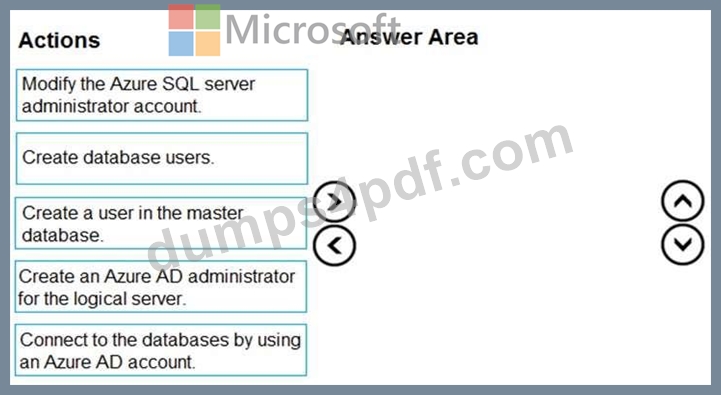
Answer:
Explanation:
Section: [none]
Explanation:
Scenario: Authenticate database users by using Active Directory credentials.
The configuration steps include the following procedures to configure and use Azure Active Directory authentication.
1. Create and populate Azure AD.
2. Optional: Associate or change the active directory that is currently associated with your Azure Subscription.
3. Create an Azure Active Directory administrator. (Step 1)
4. Configure your client computers.
5. Create contained database users in your database mapped to Azure AD identities. (Step 2)
6. Connect to your database by using Azure AD identities. (Step 3)
Reference:
https://docs.microsoft.com/en-us/azure/azure-sql/database/authentication-aad-overview Testlet 2 Case study This is a case study. Case studies are not timed separately. You can use as much exam time as you would like to complete each case. However, there may be additional case studies and sections on this exam.
You must manage your time to ensure that you are able to complete all questions included on this exam in the time provided.
To answer the questions included in a case study, you will need to reference information that is provided in the case study. Case studies might contain exhibits and other resources that provide more information about the scenario that is described in the case study. Each question is independent of the other questions in this case study.
At the end of this case study, a review screen will appear. This screen allows you to review your answers and to make changes before you move to the next section of the exam. After you begin a new section, you cannot return to this section.
To start the case study
To display the first question in this case study, click the Next button. Use the buttons in the left pane to explore the content of the case study before you answer the questions. Clicking these buttons displays information such as business requirements, existing environment, and problem statements. If the case study has an All Information tab, note that the information displayed is identical to the information displayed on the subsequent tabs. When you are ready to answer a question, click the Question button to return to the question.
Overview
General Overview
Contoso, Ltd. is a financial data company that has 100 employees. The company delivers financial data to customers.
Physical Locations
Contoso has a datacenter in Los Angeles and an Azure subscription. All Azure resources are in the US West 2 Azure region. Contoso has a 10-Gb ExpressRoute connection to Azure.
The company has customers worldwide.
Existing Environment
Active Directory
Contoso has a hybrid Azure Active Directory (Azure AD) deployment that syncs to on-premises Active Directory.
Database Environment
Contoso has SQL Server 2017 on Azure virtual machines shown in the following table.
SQL1 and SQL2 are in an Always On availability group and are actively queried. SQL3 runs jobs, provides historical data, and handles the delivery of data to customers.
The on-premises datacenter contains a PostgreSQL server that has a 50-TB database.
Current Business Model
Contoso uses Microsoft SQL Server Integration Services (SSIS) to create flat files for customers. The customers receive the files by using FTP.
Requirements
Planned Changes
Contoso plans to move to a model in which they deliver data to customer databases that run as platform as a service (PaaS) offerings. When a customer establishes a service agreement with Contoso, a separate resource group that contains an Azure SQL database will be provisioned for the customer. The database will have a complete copy of the financial data. The data to which each customer will have access will depend on the service agreement tier. The customers can change tiers by changing their service agreement.
The estimated size of each PaaS database is 1 TB.
Contoso plans to implement the following changes:
* Move the PostgreSQL database to Azure Database for PostgreSQL during the next six months.
* Upgrade SQL1, SQL2, and SQL3 to SQL Server 2019 during the next few months.
* Start onboarding customers to the new PaaS solution within six months.
Business Goals
Contoso identifies the following business requirements:
* Use built-in Azure features whenever possible.
* Minimize development effort whenever possible.
* Minimize the compute costs of the PaaS solutions.
* Provide all the customers with their own copy of the database by using the PaaS solution.
* Provide the customers with different table and row access based on the customer's service agreement.
* In the event of an Azure regional outage, ensure that the customers can access the PaaS solution with minimal downtime. The solution must provide automatic failover.
* Ensure that users of the PaaS solution can create their own database objects but be prevented from modifying any of the existing database objects supplied by Contoso.
Technical Requirements
Contoso identifies the following technical requirements:
* Users of the PaaS solution must be able to sign in by using their own corporate Azure AD credentials or have Azure AD credentials supplied to them by Contoso. The solution must avoid using the internal Azure AD of Contoso to minimize guest users.
* All customers must have their own resource group, Azure SQL server, and Azure SQL database. The deployment of resources for each customer must be done in a consistent fashion.
* Users must be able to review the queries issued against the PaaS databases and identify any new objects created.
* Downtime during the PostgreSQL database migration must be minimized.
Monitoring Requirements
Contoso identifies the following monitoring requirements:
* Notify administrators when a PaaS database has a higher than average CPU usage.
* Use a single dashboard to review security and audit data for all the PaaS databases.
* Use a single dashboard to monitor query performance and bottlenecks across all the PaaS databases.
* Monitor the PaaS databases to identify poorly performing queries and resolve query performance issues automatically whenever possible.
PaaS Prototype
During prototyping of the PaaS solution in Azure, you record the compute utilization of a customer's Azure SQL database as shown in the following exhibit.
Role Assignments
For each customer's Azure SQL Database server, you plan to assign the roles shown in the following exhibit.
NEW QUESTION 33
You are designing a star schema for a dataset that contains records of online orders. Each record includes an order date, an order due date, and an order ship date.
You need to ensure that the design provides the fastest query times of the records when querying for arbitrary date ranges and aggregating by fiscal calendar attributes.
Which two actions should you perform? Each correct answer presents part of the solution.
NOTE: Each correct selection is worth one point.
- A. Create a date dimension table that has a DateTime key.
- B. Use DateTime columns for the date fields.
- C. Use integer columns for the date fields.
- D. Create a date dimension table that has an integer key in the format of YYYYMMDD.
- E. Use built-in SQL functions to extract date attributes.
Answer: C,D
Explanation:
Section: [none]
Explanation/Reference:
https://community.idera.com/database-tools/blog/b/community_blog/posts/why-use-a-date-dimension-table-in- a-data-warehouse
NEW QUESTION 34
HOTSPOT
You are evaluating the role assignments.
For each of the following statements, select Yes if the statement is true. Otherwise, select No.
NOTE: Each correct selection is worth one point.
Hot Area:
Answer:
Explanation:
Section: [none]
Explanation:
Box 1: Yes
DBAGroup1 is member of the Contributor role.
The Contributor role grants full access to manage all resources, but does not allow you to assign roles in Azure RBAC, manage assignments in Azure Blueprints, or share image galleries.
Box 2: No
Box 3: Yes
DBAGroup2 is member of the SQL DB Contributor role.
The SQL DB Contributor role lets you manage SQL databases, but not access to them. Also, you can't manage their security-related policies or their parent SQL servers. As a member of this role you can create and manage SQL databases.
Reference:
https://docs.microsoft.com/en-us/azure/role-based-access-control/built-in-roles Question Set 3
NEW QUESTION 35
A data engineer creates a table to store employee information for a new application. All employee names are in
the US English alphabet. All addresses are locations in the United States. The data engineer uses the following
statement to create the table.
You need to recommend changes to the data types to reduce storage and improve performance.
Which two actions should you recommend? Each correct answer presents part of the solution.
NOTE: Each correct selection is worth one point.
- A. Change PhoneNumberto the floatdata type.
- B. Change Salaryto the moneydata type.
- C. Change LastHireDateto the datedata type.
- D. Change LastHireDate to the datetime2(7)data type.
- E. Change PhoneNumberto the bigintdata type.
Answer: B,C
Explanation:
Section: [none]
NEW QUESTION 36
You have an Azure SQL Database server named sqlsrv1 that hosts 10 Azure SQL databases.
The databases perform slower than expected.
You need to identify whether the performance issue relates to the use of tempdb by Azure SQL databases on
sqlsrv1.
What should you do?
- A. Review information provided by SQL Server Profiler-based traces
- B. Review information provided by Query Performance Insight
- C. Run dynamic management view-based queries
- D. Run Query Store-based queries
Answer: C
Explanation:
Section: [none]
Explanation:
The diagnostics log outputs tempDB contention details. You can use the information as the starting point for
troubleshooting.
You can use the Intelligent Insights performance diagnostics log of Azure SQL Database to troubleshoot
performance issues.
Reference:
https://docs.microsoft.com/en-us/azure/azure-sql/database/intelligent-insights-troubleshoot-
performance#tempdb-contention
https://docs.microsoft.com/en-us/azure/azure-sql/database/intelligent-insights-use-diagnostics-log
NEW QUESTION 37
Which audit log destination should you use to meet the monitoring requirements?
- A. Azure Storage
- B. Azure Log Analytics
- C. Azure Event Hubs
Answer: B
Explanation:
Scenario: Use a single dashboard to review security and audit data for all the PaaS databases.
With dashboards can bring together operational data that is most important to IT across all your Azure resources, including telemetry from Azure Log Analytics.
Note: Auditing for Azure SQL Database and Azure Synapse Analytics tracks database events and writes them to an audit log in your Azure storage account, Log Analytics workspace, or Event Hubs.
Reference:
https://docs.microsoft.com/en-us/azure/azure-monitor/visualize/tutorial-logs-dashboards
Topic 2, Litware
Existing Environment
Network Environment
The manufacturing and research datacenters connect to the primary datacenter by using a VPN.
The primary datacenter has an ExpressRoute connection that uses both Microsoft peering and private peering. The private peering connects to an Azure virtual network named HubVNet.
Identity Environment
Litware has a hybrid Azure Active Directory (Azure AD) deployment that uses a domain named litwareinc.com. All Azure subscriptions are associated to the litwareinc.com Azure AD tenant.
Database Environment
The sales department has the following database workload:
An on-premises named SERVER1 hosts an instance of Microsoft SQL Server 2012 and two 1-TB databases.
A logical server named SalesSrv01A contains a geo-replicated Azure SQL database named SalesSQLDb1. SalesSQLDb1 is in an elastic pool named SalesSQLDb1Pool. SalesSQLDb1 uses database firewall rules and contained database users.
An application named SalesSQLDb1App1 uses SalesSQLDb1.
The manufacturing office contains two on-premises SQL Server 2016 servers named SERVER2 and SERVER3. The servers are nodes in the same Always On availability group. The availability group contains a database named ManufacturingSQLDb1 Database administrators have two Azure virtual machines in HubVnet named VM1 and VM2 that run Windows Server 2019 and are used to manage all the Azure databases.
Licensing Agreement
Litware is a Microsoft Volume Licensing customer that has License Mobility through Software Assurance.
Current Problems
SalesSQLDb1 experiences performance issues that are likely due to out-of-date statistics and frequent blocking queries.
Requirements
Planned Changes
Litware plans to implement the following changes:
Implement 30 new databases in Azure, which will be used by time-sensitive manufacturing apps that have varying usage patterns. Each database will be approximately 20 GB.
Create a new Azure SQL database named ResearchDB1 on a logical server named ResearchSrv01. ResearchDB1 will contain Personally Identifiable Information (PII) data.
Develop an app named ResearchApp1 that will be used by the research department to populate and access ResearchDB1.
Migrate ManufacturingSQLDb1 to the Azure virtual machine platform.
Migrate the SERVER1 databases to the Azure SQL Database platform.
Technical Requirements
Litware identifies the following technical requirements:
Maintenance tasks must be automated.
The 30 new databases must scale automatically.
The use of an on-premises infrastructure must be minimized.
Azure Hybrid Use Benefits must be leveraged for Azure SQL Database deployments.
All SQL Server and Azure SQL Database metrics related to CPU and storage usage and limits must be analyzed by using Azure built-in functionality.
Security and Compliance Requirements
Litware identifies the following security and compliance requirements:
Store encryption keys in Azure Key Vault.
Retain backups of the PII data for two months.
Encrypt the PII data at rest, in transit, and in use.
Use the principle of least privilege whenever possible.
Authenticate database users by using Active Directory credentials.
Protect Azure SQL Database instances by using database-level firewall rules.
Ensure that all databases hosted in Azure are accessible from VM1 and VM2 without relying on public endpoints.
Business Requirements
Litware identifies the following business requirements:
Meet an SLA of 99.99% availability for all Azure deployments.
Minimize downtime during the migration of the SERVER1 databases.
Use the Azure Hybrid Use Benefits when migrating workloads to Azure.
Once all requirements are met, minimize costs whenever possible.
NEW QUESTION 38
You plan to create a table in an Azure Synapse Analytics dedicated SQL pool.
Data in the table will be retained for five years. Once a year, data that is older than five years will be deleted.
You need to ensure that the data is distributed evenly across partitions. The solutions must minimize the amount of time required to delete old data.
How should you complete the Transact-SQL statement? To answer, drag the appropriate values to the correct targets. Each value may be used once, more than once, or not at all.
You may need to drag the split bar between panes or scroll to view content.
NOTE: Each correct selection is worth one point.
Answer:
Explanation:
Reference:
https://docs.microsoft.com/en-us/sql/t-sql/statements/create-table-azure-sql-data-warehouse
https://docs.microsoft.com/en-us/azure/synapse-analytics/sql/best-practices-dedicated-sql-pool
NEW QUESTION 39
......
Get information about the topics of Microsoft DP-300 Exam
Candidates must know the exam topics before they start of preparation. Because it will really help them in hitting the core. Our Microsoft DP-300 dumps will include the following topics:
- Optimize query performance (5-10%)
- Implement a secure environment (15-20%)
- Perform automation of tasks (10-15%)
- Plan and implement data platform resources (15-20%)
- Monitor and optimize operational resources (15-20%)
- Perform administration by using T-SQL (10-15%)
- Plan and implement a High Availability and Disaster Recovery (HADR) environment (15-20%)
DP-300 Exam Dumps, DP-300 Practice Test Questions: https://www.dumps4pdf.com/DP-300-valid-braindumps.html
Free DP-300 Exam Dumps to Pass Exam Easily: https://drive.google.com/open?id=1hQ49XR5oII0BZ8lGuYLnvfvD9l6Wor-7