


Pass Microsoft SC-300 Exam With Practice Test Questions Dumps Bundle
2025 Valid SC-300 test answers & Microsoft Exam PDF
NEW QUESTION # 33
You have a Microsoft 365 E5 subscription. You need to perform the following tasks:
* Identify the locations and IP addresses used by Azure AD users to sign in
* Review the Azure AD security settings and identify improvement recommendations.
* Identify changes to Azure AD users or service principle.
What should you use for each task? To answer, drag the appropriate resources to the correct requirements.
Each resource may be used once, more than once, or not at all. You may need to drag the split bar between panes or scroll to view content.
Answer:
Explanation:
Explanation
NEW QUESTION # 34
Your company has a Microsoft 365 tenant.
The company has a call center that contains 300 users. In the call center, the users share desktop computers and might use a different computer every day. The call center computers are NOT configured for biometric identification.
The users are prohibited from having a mobile phone in the call center.
You need to require multi-factor authentication (MFA) for the call center users when they access Microsoft 365 services.
What should you include in the solution?
- A. the Microsoft Authenticator app
- B. Windows Hello for Business authentication
- C. FIDO2 tokens
- D. a named network location
Answer: C
Explanation:
https://docs.microsoft.com/en-us/azure/active-directory/authentication/concept-authentication-passwordless
NEW QUESTION # 35
You need to meet the planned changes for the User administrator role.
What should you do?
- A. Modify Active Assignments.
- B. Modify Role settings
- C. Create an access review.
- D. Create an administrator unit.
Answer: B
Explanation:
Role Setting details is where you need to be: Role setting details - User Administrator Privileged Identity Management | Azure AD roles Default Setting State Require justification on activation Yes Require ticket information on activation No On activation, require Azure MFA Yes Require approval to activate No Approvers None
NEW QUESTION # 36
You need to meet the planned changes and technical requirements for App1.
What should you implement?
- A. an app configuratifon policy in Microsoft Endpoint Manager
- B. Azure AD Application Proxy
- C. a policy set in Microsoft Endpoint Manager
- D. an app registration in Azure AD
Answer: D
Explanation:
Reference:
https://docs.microsoft.com/en-us/azure/active-directory/develop/quickstart-register-app
NEW QUESTION # 37
You have a Microsoft 365 tenant.
You need to Identity users who have leaked credentials. The solution must meet the following requirements:
* Identity sign-ms by users who are suspected of having leaked credentials.
* Flag the sign-ins as a high-risk event.
* Immediately enforce a control to mitigate the risk, while still allowing the user to access applications.
What should you use? To answer, select the appropriate options m the answer area.
Answer:
Explanation:
Explanation:
NEW QUESTION # 38
Your company has an Azure Active Directory (Azure AD) tenant named contoso.com.
The company is developing a web service named App1.
You need to ensure that App1 can use Microsoft Graph to read directory data in contoso.com.
Which three actions should yon perform in sequence? To answer, move the appropriate actions from the list of actions to the answer area and arrange them In the correct order.
Answer:
Explanation:
Explanation:
Create an app registration:
Your app must be registered with the Microsoft identity platform and be authorized by either a user or an administrator for access to the Microsoft Graph resources it needs.
Grant admin consent:
Higher-privileged permissions require administrator consent.
Add app permissions:
After the consents to permissions for your app, your app can acquire access tokens that represent the app's permission to access a resource in some capacity. Encoded inside the access token is every permission that your app has been granted for that resource.
Reference:
https://docs.microsoft.com/en-us/graph/auth/auth-concepts
NEW QUESTION # 39
You have an Azure Ad tenant that contains the users show in the following table.
You create a dynamic user group and configure the following rule syntax.
Which users will be added to the group?
- A. User1 only
- B. User3 only
- C. User1 and User2 only
- D. User2 only
- E. User1 and User3 only
- F. User1, User2, and User3
Answer: C
NEW QUESTION # 40
You have a Microsoft 365 E5 subscription that contains three groups named Groups1, Group2, and Group3, and the users shown in the following table.
You create a Conditional Access policy named CAT that has the following settings:
* Users
* Include
#Users and groups: Group1
o Exclude
#Users and groups: Group2
#Directory roles: Global Administrator
o Target resources
#Include: All cloud apps
o Access controls
#Grant: Require multifactor authentication
You create a Conditional Access policy named CA2 that has the following settings:
* Users
* Include
#Users and groups: Group2
o Exclude
#Users and groups: Group3
o Target resources
#Include: All cloud apps
o Access controls
#Grant: Block access
For each of the following statements, select Yes if the statement is true. Otherwise, select No.
NOTE: Each correct selection is worth one point.
Answer:
Explanation:
Explanation:
NEW QUESTION # 41
You have an Azure Active Directory (Azure AD) tenant that syncs to an Active Directory domain.
The on-premises network contains a VPN server that authenticates to the on-premises Active Directory domain. The VPN server does NOT support Azure Multi-Factor Authentication (MFA).
You need to recommend a solution to provide Azure MFA for VPN connections.
What should you include in the recommendation?
- A. an Azure AD Password Protection proxy
- B. Azure AD Application Proxy
- C. a pass-through authentication proxy
- D. Network Policy Server (NPS)
Answer: D
Explanation:
NPS (Network Policy and Access Service) is like a middle man between the VPN client and Azure MFA. The NPS role is installed on a domain-joined server or the domain controller and is configured to authenticate and authorize RADIUS requests from the VPN client.
The VPN should be configured to use RADIUS authentication and point to the NPS server.
The MFA NPS extension is installed anywhere but the VPN server. When a user/VPN client attempts to authenticate, it sends a RADIUS request to the NPS server through the VPN which performs the primary authentication and then triggers the NPS Extension for secondary authentication.
https://docs.microsoft.com/en-us/azure/active-directory/authentication/howto-mfa-nps-extension- vpn
NEW QUESTION # 42
Task 4
You need to ensure that all users can consent to apps that require permission to read their user profile. Users must be prevented from consenting to apps that require any other permissions.
Answer:
Explanation:
See the Explanation below for complete Solution.
Explanation:
To ensure that all users can consent to apps that require permission to read their user profile while preventing them from consenting to apps that require any other permissions, you can follow these steps:
* Sign in to the Microsoft Entra admin center:
* Use an account with Global Administrator privileges.
* Navigate to User Consent Settings:
* Go to Enterprise applications > Consent and permissions > User consent settings.
* Configure User Consent Permissions:
* Under User consent for applications, select the option to Allow user consent for apps from verified publishers.
* For the permissions, choose the ones that allow reading the user profile, such as User.Read.
* Ensure that all other permissions are not selected, thus preventing users from consenting to apps that require additional permissions.
* Save Your Settings:
* Click Save to apply the new settings.
By following these steps, you will have configured the Azure AD environment to allow users to give consent to applications that need to read their user profile information, but not to any applications that require additional permissions
NEW QUESTION # 43
You have a Microsoft 365 E5 subscription that contains a Microsoft SharePoint Online site named Site1 and the users shown in the following table.
The users have the devices shown in the following table.
You create the following two Conditional Access policies:
* Name: CAPolicy1
* Assignments
o Users or workload identities: Group 1
o Cloud apps or actions: Office 365 SharePoint Online
o Conditions
Filter for devices: Exclude filtered devices from the policy
Rule syntax: device.displayName -starts With "Device*"
o Access controls
Grant: Block access
Session: 0 controls selected
o Enable policy: On
* Name: CAPolicy2
* Assignments
o Users or workload identities: Group2
o Cloud apps or actions: Office 365 SharePoint Online
o Conditions: 0 conditions selected
* Access controls
o Grant: Grant access
Require multifactor authentication
o Session:
0 controls selected
* Enable policy: On
All users confirm that they can successfully authenticate using MFA.
For each of the following statements, select Yes if the statement is true. Otherwise, select No.
NOTE: Each correct selection is worth one point.
Answer:
Explanation:
Explanation:
A screenshot of a computer Description automatically generated
NEW QUESTION # 44
You have a Microsoft Entra tenant.
You configure self-service password reset (SSPR) with the following settings:
* Require users to register when signing in: Yes
* Number of methods required to reset: 1
What is a valid authentication method available to users?
- A. An FIDO2 security token
- B. A Windows Hello PIN
- C. A mobile app code
- D. A smartcard
Answer: C
Explanation:
Comprehensive and Detailed In-Depth Explanation:
Let's break this down step by step based on Microsoft Entra ID self-service password reset (SSPR) settings and the available authentication methods, as outlined in Microsoft Identity and Access Administrator documentation.
* Understanding Self-Service Password Reset (SSPR) in Microsoft Entra ID:
* Self-service password reset (SSPR) allows users to reset their passwords without administrator intervention, improving security and reducing helpdesk workload.
* The settings provided are:
* Require users to register when signing in: Yes- Users must register their authentication methods (e.g., phone number, email, security questions) the first time they sign in. This ensures they have methods available for SSPR.
* Number of methods required to reset: 1- Users must verify their identity using one authentication method to reset their password. This is the minimum number of methods required, meaning users must have at least one method registered, and they will use one method during the reset process.
* Available Authentication Methods for SSPR:
* Microsoft Entra ID SSPR supports a specific set of authentication methods that users can use to verify their identity during a password reset. These methods are configured by the administrator in the Microsoft Entra admin center under "Password reset" settings.
* The default authentication methods available for SSPR include:
* Email:Users receive a code sent to an alternate email address.
* Mobile phone (SMS):Users receive a code via SMS to their registered mobile phone.
* Mobile app code:Users use a code generated by the Microsoft Authenticator app (or another compatible authenticator app).
* Mobile app notification:Users receive a push notification in the Microsoft Authenticator app to approve the reset.
* Security questions:Users answer predefined security questions they set up during registration.
* Important Note:Methods like smartcards, FIDO2 security tokens, and Windows Hello are not supported for SSPR. These methods are typically used for authentication during sign-in (e.g., MFA or passwordless sign-in), not for the SSPR process.
* Analysis of the Options:
* A. A smartcard:
* Smartcards are a form of certificate-based authentication often used for sign-in to Windows devices or VPNs. They require a physical card and a reader, and they are typically used for primary authentication, not for SSPR.
* Microsoft Entra ID SSPR does not support smartcards as an authentication method for password reset. Smartcards are not listed as an available method in the SSPR configuration settings.
* Conclusion:This is incorrect.
* B. A mobile app code:
* A mobile app code refers to a time-based one-time password (TOTP) generated by an authenticator app, such as the Microsoft Authenticator app.
* This is a supported method for SSPR in Microsoft Entra ID. Users can register the Microsoft Authenticator app (or another compatible app) and use the generated code to verify their identity during a password reset.
* Since the setting "Number of methods required to reset: 1" means only one method is needed, a mobile app code is a valid option if the user has registered it.
* Conclusion:This is correct.
* C. An FIDO2 security token:
* FIDO2 security tokens (e.g., YubiKey) are hardware-based security keys that support passwordless authentication in Microsoft Entra ID. They are part of Microsoft's passwordless authentication strategy and can be used for sign-in.
* However, FIDO2 security tokens are not supported for SSPR. The SSPR process does not allow users to verify their identity using a FIDO2 security key because the reset process is designed to work with simpler, more accessible methods like email, SMS, or app-based codes.
* Conclusion:This is incorrect.
* D. A Windows Hello PIN:
* Windows Hello PIN is a device-specific authentication method used to sign in to Windows devices. It is part of Windows Hello, which also includes biometric authentication (e.g., facial recognition, fingerprint).
* Windows Hello PIN is not supported for SSPR in Microsoft Entra ID. The SSPR process occurs in a web-based portal (e.g., aka.ms/sspr) and does not integrate with device-specific authentication methods like Windows Hello. Additionally, Windows Hello PIN is tied to a specific device, whereas SSPR is designed to be device-agnostic.
* Conclusion:This is incorrect.
* Additional Considerations:
* The setting "Require users to register when signing in: Yes" ensures that users have at least one authentication method registered. However, the question does not specify which methods are enabled by the administrator. In Microsoft Entra ID, the default enabled methods for SSPR typically include email, mobile phone (SMS), mobile app code, and mobile app notification.
Security questions may also be enabled but are less common due to security concerns.
* If the administrator has disabled certain methods (e.g., mobile app code), the answer could change. However, the question does not indicate any such restrictions, so we assume the default methods are available.
* The "Number of methods required to reset: 1" setting means users only need to use one method to reset their password, but they may have multiple methods registered. The question asks for a
"valid authentication method available to users," so we need to identify a method that SSPR supports.
* Conclusion:Based on the SSPR settings and the supported authentication methods in Microsoft Entra ID:
* A mobile app code (option B) is a valid authentication method for SSPR, as it is supported by default and aligns with the configuration.
* Smartcards, FIDO2 security tokens, and Windows Hello PIN are not supported for SSPR.
Therefore, the correct answer isB.
References:
Microsoft Entra ID documentation: "Self-service password reset authentication methods" (Microsoft Learn:
https://learn.microsoft.com/en-us/entra/identity/authentication/concept-sspr-howitworks#authentication- methods) Microsoft Entra ID documentation: "Configure self-service password reset" (Microsoft Learn:https://learn.
microsoft.com/en-us/entra/identity/authentication/howto-sspr-deployment) Microsoft Identity and Access Administrator (SC-300) exam study guide, which covers SSPR configuration and supported authentication methods.
NEW QUESTION # 45
You have a Microsoft 365 E5 subscription and an Azure subscription. You need to meet the following requirements:
* Ensure that users can sign in to Azure virtual machines by using their Microsoft 365 credentials.
* Delegate the ability to create new virtual machines.
What should you use for each requirement? To answer, drag the appropriate features to the correct requirements. Each feature may be used once, more than once, or not at all. You may need to drag the split bar between panes or scroll to view content.
Answer:
Explanation:
NEW QUESTION # 46
You have a Microsoft 365 tenant.
You configure a conditional access policy as shown in the Conditional Access policy exhibit. (Click the Conditional Access policy tab.)
You view the User administrator role settings as shown in the Role setting details exhibit. (Click the Role setting details tab.)
You view the User administrator role assignments as shown in the Role assignments exhibit. (Click the Role assignments lab.)
For each of the following statement, select Yes if the statement is true. Otherwise, select No.
NOTE: Each correct selection is worth one point.
Answer:
Explanation:
NEW QUESTION # 47
You need to resolve the recent security incident issues.
What should you configure for each incident? To answer, drag the appropriate policy types to the correct issues. Each policy type may be used once, more than once, or not at all. You may need to drag the split bar between panes or scroll to view content.
NOTE: Each correct selection is worth one point.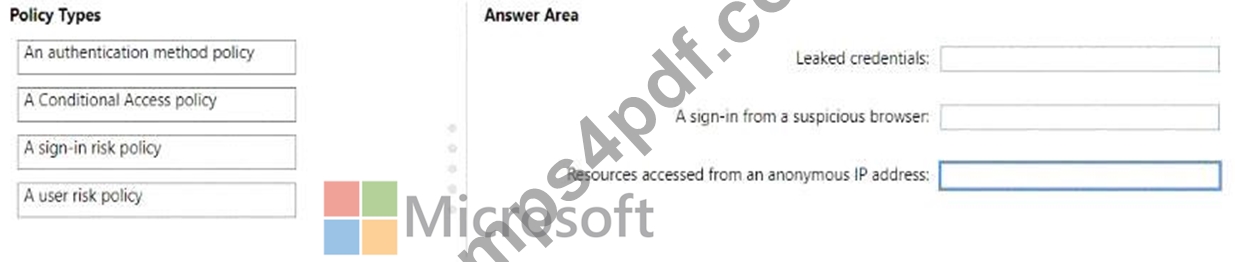
Answer:
Explanation:
Explanation
NEW QUESTION # 48
You have a Microsoft 365 E5 subscription that contains two users named User1 and User2.
You need to ensure that User1 can create access reviews for groups, and that User2 can review the history report for all the completed access reviews. The solution must use the principle of least privilege.
Which role should you assign to each user? To answer, drag the appropriate roles to the correct users. Each role may be used once, more than once, or not at all. You may need to drag the split bar between panes or scroll to view content NOTE: Each correct selection is worth one point.
Answer:
Explanation:
Explanation:
NEW QUESTION # 49
You have an Azure subscription.
Azure AD logs are sent to a Log Analytics workspace.
You need to query the logs and graphically display the number of sign-ins per user.
How should you complete the query? To answer, select the appropriate options in the answer area.
Answer:
Explanation:
Explanation:
Box 1 =
SigninLogs
| where ResultType == 0
| summarize login_count = count() by identity
| render piechart
This query retrieves the sign-in logs, filters the successful sign-ins,summarizesthe count of sign-ins per user, and renders the result as a pie chart.
Box 2 = Render
NEW QUESTION # 50
You have an Azure subscription.
Azure AD logs are sent to a Log Analytics workspace.
You need to query the logs and graphically display the number of sign-ins per user.
How should you complete the query? To answer, select the appropriate options in the answer area.
Answer:
Explanation:
Explanation:
Box 1 =
SigninLogs
| where ResultType == 0
| summarize login_count = count() by identity
| render piechart
This query retrieves the sign-in logs, filters the successful sign-ins,summarizesthe count of sign-ins per user, and renders the result as a pie chart.
Box 2 = Render
NEW QUESTION # 51
You have an Azure Active Directory (Azure AD) tenant that contains the objects shown in the following table.
Which objects can you add as eligible in Azure Privileged identity Management (PIM) for an Azure AD role?
- A. User1 and Guest1 only
- B. User1 and Identity1 only
- C. User1 only
- D. User1. Guest1, and Identity
Answer: A
Explanation:
Reference:
https://docs.microsoft.com/en-us/azure/active-directory/privileged-identity-management/pim-deployment-plan
NEW QUESTION # 52
You have an Azure Active Directory (Azure AD) tenant that contains the users shown in the following table.
For which users can you configure the Job title property and the Usage location property in Azure AD? To answer, select the appropriate options in the answer area.
NOTE: Each correct selection is worth one point.
Answer:
Explanation:
NEW QUESTION # 53
You need to create the LWGroup1 group to meet the management requirements.
How should you complete the dynamic membership rule? To answer, drag the appropriate values to the correct targets. Each value may be used once, more than once, or not at all. You many need to drag the split bar between panes or scroll to view content.
NOTE: Each correct selection is worth one point.
Answer:
Explanation:
NEW QUESTION # 54
You have an Azure AD tenant that contains the users shown in the following table.
In Azure AD Identity Protection, you configure a user risk policy that has the following settings:
* Assignments:
o Users: Group1
o User risk: Low and above
* Controls:
o Access: Block access
* Enforce policy: On
In Azure AD Identity Protection, you configure a sign-in risk policy that has the following settings:
* Assignments:
o Users: Group2
o Sign-in risk: Low and above
* Controls:
o Access: Require multi-factor authentication
* Enforce policy. On
the following settings:
ng settings:
For each of the following statements, select Yes if the statement is true. Otherwise, select No.
NOTE: Each correct selection is worth one point.
Answer:
Explanation:
Explanation:
NEW QUESTION # 55
......
Microsoft SC-300 is a certification exam for those who want to become a Microsoft Identity and Access Administrator. SC-300 exam is designed to measure a candidate's skills and knowledge in managing identity and access in Microsoft 365 and Azure Active Directory (Azure AD) environments. SC-300 exam is one of the requirements for obtaining the Microsoft Certified: Identity and Access Administrator Associate certification.
Top Microsoft SC-300 Courses Online: https://www.dumps4pdf.com/SC-300-valid-braindumps.html
Free Microsoft SC-300 Exam Questions and Answer from Training Expert Dumps4PDF: https://drive.google.com/open?id=1tzwZm2NEp1WizWIsnKdyLu6S1wESBr7I