


Latest [Jul 01, 2026] 300-710 Exam Questions – Valid 300-710 Dumps Pdf
300-710 Practice Test Questions Answers Updated 445 Questions
Cisco 300-710 exam covers a broad range of topics, including Cisco Firepower Management Center (FMC) configuration, NGFW policy configuration, network analysis policy configuration, and NGFW botnet traffic filtering. Candidates are also expected to demonstrate their knowledge of the integration of Cisco Identity Services Engine (ISE) with Cisco Firepower, VPN configuration, and Cisco Firepower NGFW troubleshooting. Passing 300-710 exam not only validates a candidate's skills and knowledge in securing networks with Cisco Firepower but also demonstrates their commitment to professional development and career advancement in the field of network security.
NEW QUESTION # 256
What is the result a specifying of QoS rule that has a rate limit that is greater than the maximum throughput of an interface?
- A. Matching traffic is not rate limited.
- B. The system rate-limits all traffic.
- C. The system repeatedly generates warnings.
- D. The rate-limiting rule is disabled.
Answer: A
Explanation:
Section: Configuration
Explanation/Reference: https://www.cisco.com/c/en/us/td/docs/security/firepower/620/configuration/guide/fpmc-config- guide-v62/quality_of_service_qos.pdf
NEW QUESTION # 257
Which command is run on an FTD unit to associate the unit to an FMC manager that is at IP address
10.0.0.10, and that has the registration key Cisco123?
- A. configure manager add 10.0.0.10 Cisco123
- B. configure manager add Cisco123 10.0.0.10
- C. configure manager local 10.0.0.10 Cisco123
- D. configure manager local Cisco123 10.0.0.10
Answer: A
Explanation:
Reference: https://www.cisco.com/c/en/us/td/docs/security/firepower/misc/fmc-ftd-mgmt-nw/fmc-ftd-mgmt- nw.html#id_106101
NEW QUESTION # 258
Refer to the exhibit.
An engineer is modifying an access control policy to add a rule to Inspect all DNS traffic that passes it making the change and deploying the policy, they see that DNS traffic Is not being Inspected by the Snort engine.
What is......
- A. The rule must define the source network for inspection as well as the port.
- B. The action of the rule is set to trust instead of allow.
- C. The rule must specify the security zone that originates the traffic.
- D. The rule Is configured with the wrong setting for the source port.
Answer: B
NEW QUESTION # 259
The event dashboard within the Cisco FMC has been inundated with low priority intrusion drop events, which are overshadowing high priority events. An engineer has been tasked with reviewing the policies and reducing the low priority events. Which action should be configured to accomplish this task?
- A. generate events
- B. drop connection
- C. drop packet
- D. drop and generate
Answer: A
Explanation:
Section: Deployment
Explanation/Reference:
Reference" https://www.cisco.com/c/en/us/td/docs/security/firepower/620/configuration/guide/fpmc-config- guide-v62/working_with_intrusion_events.html
NEW QUESTION # 260
Which two OSPF routing features are configured in Cisco FMC and propagated to Cisco FTD?
(Choose two.)
- A. virtual links
- B. MD5 authentication to OSPF packets
- C. area boundary router type 1 LSA filtering
- D. OSPFv2 with IPv6 capabilities
- E. SHA authentication to OSPF packets
Answer: A,B
Explanation:
The Firepower Threat Defense device supports the following OSPF features:
Intra-area, inter-area, and external (Type I and Type II) routes.
Virtual links.
LSA flooding.
Authentication to OSPF packets (both password and MD5 authentication).
Configuring the Firepower Threat Defense device as a designated router or a designated backup router. The Firepower Threat Defense device also can be set up as an ABR.
Stub areas and not-so-stubby areas.
Area boundary router Type 3 LSA filtering.
https://www.cisco.com/c/en/us/td/docs/security/firepower/610/configuration/guide/fpmc-config- guide-v61/ospf_for_firepower_threat_defense.html
NEW QUESTION # 261
An engineer must create a basic access control policy in the Cisco Secure Firewall Management Center to block all traffic by default. Drag and drop the configuration actions from the left into sequence on the right.
Answer:
Explanation:

NEW QUESTION # 262
Which two tasks can the network discovery feature perform? (Choose two)
- A. route traffic
- B. Block traffic
- C. host discovery
- D. reset connection
- E. user discovery
Answer: C,E
NEW QUESTION # 263
An engineer configures a network discovery policy on Cisco FMC. Upon configuration, it is noticed that excessive and misleading events filing the database and overloading the Cisco FMC. A monitored NAT device is executing multiple updates of its operating system in a short period of time. What configuration change must be made to alleviate this issue?
- A. Increase the number of entries on the NAT device.
- B. Change the method to TCP/SYN.
- C. Exclude load balancers and NAT devices.
- D. Leave default networks.
Answer: C
NEW QUESTION # 264
A network administrator is troubleshooting access to a website hosted behind a Cisco FTD device External clients cannot access the web server via HTTPS The IP address configured on the web server is 192 168 7.46 The administrator is running the command capture CAP interface outside match ip any 192.168.7.46
255.255.255.255 but cannot see any traffic in the capture Why is this occurring?
- A. The packet capture shows only blocked traffic
- B. The FTD has no route to the web server.
- C. Theaccess policy is blocking the traffic.
- D. The capture must use the public IP address of the web server.
Answer: D
NEW QUESTION # 265
An engineer is troubleshooting a device that cannot connect to a web server. The connection is initiated from the Cisco FTD inside interface and attempting to reach 10.0.1.100 over the non-standard port of 9443 The host the engineer is attempting the connection from is at the IP address of 10.20.10.20. In order to determine what is happening to the packets on the network, the engineer decides to use the FTD packet capture tool Which capture configuration should be used to gather the information needed to troubleshoot this issue?
A)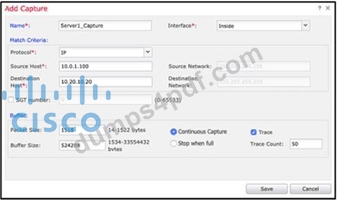
B)
C)
D)
- A. Option B
- B. Option C
- C. Option D
- D. Option A
Answer: A
NEW QUESTION # 266
A network administrator is configuring Snort inspection policies and is seeing failed deployment messages in Cisco FMC. What information should the administrator generate for Cisco TAC to help troubleshoot?
- A. A "troubleshoot" file for the Cisco FMC.
- B. A "show tech" file for the device in question.
- C. A "show tech" for the Cisco FMC.
- D. A "troubleshoot" file for the device in question.
Answer: D
NEW QUESTION # 267
An engineer currently has a Cisco FTD device registered to the Cisco FMC and is assigned the address of 10
10.50.12. The organization is upgrading the addressing schemes and there is a requirement to convert the addresses to a format that provides an adequate amount of addresses on the network What should the engineer do to ensure that the new addressing takes effect and can be used for the Cisco FTD to Cisco FMC connection?
- A. Cisco FMC does not support devices that use IPv4 IP addresses.
- B. Update the IP addresses from IFV4 to IPv6 without deleting the device from Cisco FMC
- C. Format and reregister the device to Cisco FMC.
- D. Delete and reregister the device to Cisco FMC
Answer: B
NEW QUESTION # 268
An organization is implementing Cisco FTD using transparent mode in the network. Which rule in the default Access Control Policy ensures that this deployment does not create a loop in the network?
- A. ARP packets are allowed by default.
- B. STP BPDU packets are allowed by default.
- C. Multicast and broadcast packets are denied by default.
- D. ARP inspection is enabled by default.
Answer: C
NEW QUESTION # 269
Which command-line mode is supported from the Cisco Firepower Management Center CLI?
- A. user
- B. privileged
- C. admin
- D. configuration
Answer: D
Explanation:
Reference: https://www.cisco.com/c/en/us/td/docs/security/firepower/660/configuration/guide/fpmc-config-guide-v66/command_line_reference.pdf
NEW QUESTION # 270
An engineer is deploying a Cisco Secure Firewall Management Center appliance. The company must send data to Cisco Secure Network Analytics appliances. Which two actions must the engineer take? (Choose two.)
- A. Add the Netflow_Set_Parameters object to the configuration.
- B. Create a service identifier to enable the NetFlow service.
- C. Security Intelligence object to send data to Cisco Secure Network Analytics
- D. Add the Netflow_Add_Destination object to the configuration.
- E. Add the Netflow_Send_Destination object to the configuration.
Answer: A,D
Explanation:
https://www.cisco.com/c/en/us/support/docs/quality-of-service-qos/netflow/216126-configure- netflow-secure-event-logging- o.html#:~:text=The%20four%20predefined%20objects%20are%20listed%20in%20the%20table%
3A
NEW QUESTION # 271
Which process should be checked when troubleshooting registration issues between Cisco FMC and managed devices to verify that secure communication is occurring?
- A. sfmgr
- B. fpcollect
- C. sftunnel
- D. dhclient
Answer: C
NEW QUESTION # 272
An organization is migrating their Cisco ASA devices running in multicontext mode to Cisco FTD devices. Which action must be taken to ensure that each context on the Cisco ASA is logically separated in the Cisco FTD devices?
- A. Add a native instance to distribute traffic to each Cisco FTD context.
- B. Add the Cisco FTD device to the Cisco ASA port channels.
- C. Configure the Cisco FTD to use port channels spanning multiple networks.
- D. Configure a container instance in the Cisco FTD for each context in the Cisco ASA.
Answer: D
NEW QUESTION # 273
An engineer must investigate a connectivity issue and decides to use the packet capture feature on Cisco FTD. The goal is to see the real packet going through the Cisco FTD device and see Snort detection actions as a part of the output. After the capture-traffic command is issued, only the packets are displayed. Which action resolves this issue?
- A. Use the capture command and specify the trace option to get the required information
- B. Use the verbose option as a part of the capture-traffic command
- C. Specify the trace using the -T option after the capture-traffic command
- D. Perform the trace within the Cisco FMC GUI instead of the Cisco FMC CLI
Answer: A
Explanation:
Using the capture command and specifying the trace option is the solution to this issue. The capture-traffic command only captures traffic and displays it in a packet capture file, without showing any Snort detection actions.
https://www.cisco.com/c/en/us/support/docs/security/firepower-ngfw/212474-working-with- firepower-threat-defense-f.html#anc29
NEW QUESTION # 274
Refer to the exhibit.
A systems administrator conducts a connectivity test to their SCCM server from a host machine and gets no response from the server. Which action ensures that the ping packets reach the destination and that the host receives replies?
- A. Create an ICMP allow list and add the ICMP destination to remove it from the implicit deny list.
- B. Create an access control policy rule that allows ICMP traffic.
- C. Configure a custom Snort signature to allow ICMP traffic after Inspection.
- D. Modify the Snort rules to allow ICMP traffic.
Answer: B
NEW QUESTION # 275
A software development company hosts the website https://dev.company.com for contractors to share code for projects they are working on with internal developers. The web server is on premises and is protected by a Cisco Secure Firewall Threat Defense appliance. The network administrator is worried about someone trying to transmit infected files to internal users via this site. Which type of policy must be associated with an access control policy to enable Cisco Secure Firewall Malware Defense to detect and block malware?
- A. prefilter policy
- B. network discovery policy
- C. file policy
- D. SSL policy
Answer: C
Explanation:
To enable Cisco Secure Firewall Malware Defense to detect and block malware transmitted through a web server, you must associate a file policy with an access control policy.
A file policy is a set of configurations that the Secure Firewall uses to inspect files in network traffic for malware. By associating file policies with access control rules, the firewall inspects files before allowing them through, enabling detection and blocking of malware in transmitted files.
This is essential for controlling file-based threats coming from sources like web servers, email, or other vectors.
https://secure.cisco.com/secure-firewall/docs/malware-and-file-policy
NEW QUESTION # 276
A company wants a solution to aggregate the capacity of two Cisco FTD devices to make the best use of resources such as bandwidth and connections per second. Which order of steps must be taken across the Cisco FTDs with Cisco FMC to meet this requirement?
- A. Add members to Cisco FMC, configure Cisco FTD interfaces in Cisco FMC. configure cluster members in Cisco FMC, create cluster in Cisco FMC. and configure cluster members in Cisco FMC.
- B. Add members to the Cisco FMC, configure Cisco FTD interfaces, create the cluster in Cisco FMC, and configure cluster members in Cisco FMC.
- C. Configure the Cisco FTD interfaces, add members to FMC, configure cluster members in FMC, and create cluster in Cisco FMC.
- D. Configure the Cisco FTD interfaces and cluster members, add members to Cisco FMC. and create the cluster in Cisco FMC.
Answer: B
NEW QUESTION # 277
......
300-710 dumps Sure Practice with 445 Questions: https://www.dumps4pdf.com/300-710-valid-braindumps.html
Get New 300-710 Certification – Valid Exam Dumps Questions: https://drive.google.com/open?id=1otSU3YtVhE4voQOB7foe-64PSo16V_BR