


[Jun-2026] Level 4 Diploma in Procurement and Supply L4M7 Exam Practice Test Questions Dumps Bundle!
2026 Updated L4M7 PDF for the L4M7 Tests Free Updated Today!
CIPS L4M7 (CIPS Whole Life Asset Management) Exam is a globally recognized certification program designed for professionals who want to develop their skills and knowledge in the field of asset management. CIPS Whole Life Asset Management certification program is specifically designed for individuals who work in the public and private sectors, and who are responsible for managing assets throughout their entire lifecycle. The CIPS L4M7 Exam covers a wide range of topics, including asset management strategies, planning, design, construction, operation, maintenance, and disposal. The program is ideal for professionals who want to enhance their skills and knowledge in asset management and take their career to the next level.
CIPS L4M7 exam is a highly respected certification for professionals in the field of asset management. It covers a range of topics related to whole life asset management and is recognized worldwide. CIPS Whole Life Asset Management certification is suitable for professionals with a background in asset management or related fields and can help them advance in their careers and take on more senior roles.
NEW QUESTION # 113
Which of the following should be considered when an organisation plans for disposing obsolescent and redundant stock? Select TWO that apply.
- A. Financial costs
- B. Takt time
- C. ABC analysis
- D. Economic order quantity
- E. Environmental issues
Answer: A,E
Explanation:
If the planning and mitigation measures fail and redundant or obsolete stock is identified, it needs to be removed from the current inventory location as quickly as possible. There are some methods to deal with these types of stock. The worst case scenario is disposal to landfill, which is inadvisable if it can be avoided, both from environment point of view and the financial costs of such disposal.
For example, the problem of obsolete pesticides remains extremely serious and urgent. Many of the stocks identified continue to deteriorate thereby giving rise to an ever escalating source of severe pollution and posing a threat to human health, the environment and development in particular. To reduce the impact of obsolete pesticides on environment, FAO initiated a project in Yemen in which a total of 262 tonnes of obsolete pesticides were removed from 20 different sites and successfully disposed of between March and June 1996. The major field operation was completed in six weeks during which period almost all obsolete pesticides were brought to a central location and subsequently shipped to the United Kingdom for incineration.
Reference: CIPS study guide page 89
LO 2, AC 2.1
NEW QUESTION # 114
Which of the following is the material handling equipment which uses the suction force to lift an item?
- A. Dolly
- B. Sack truck
- C. Pallet stacker
- D. Vacuum lifter
Answer: D
Explanation:
VACUUM LIFTER uses the vacuum pad which attaches itself to a product. The suction force al-lows the product to be lifted (and rotated and placed). Vacuum lifters are used for moving and positioning glass sheets, but are also seen lifting boxes, plastic sacks, sheets of building materials and pipework. Some models feature hydraulic arms which allow easy movement of the lifted load. The lifting system will have a number of sucker pads and vacuum capability which determines the maximum weights and largest items that can be lifted.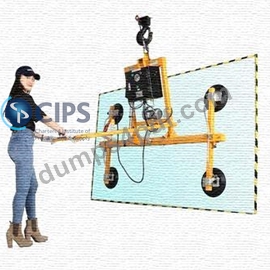
DOLLY consists of stack and sets of wheels (either casters or rollers) under the stack that allow the dolly and the heavy object on top of it to move easily and smoothly. For moving in a straight line, rollers is ideal. If you want to move manoeuvrability, dolly with sets of casters will let you swivel and turn.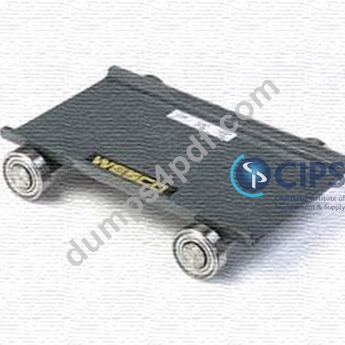
SACK TRUCK (hand truck) is an L-shaped box-moving handcart. It comprises a small base plat-form with two wheels at the base and a larger vertical structure. A small ledge to set objects on flat against the floor when the sack truck is upright. When moving, the truck and object are then tilted backward based on the vertical structure until the weight is balanced over the large wheels, making otherwise bulky and heavy objects easier to move.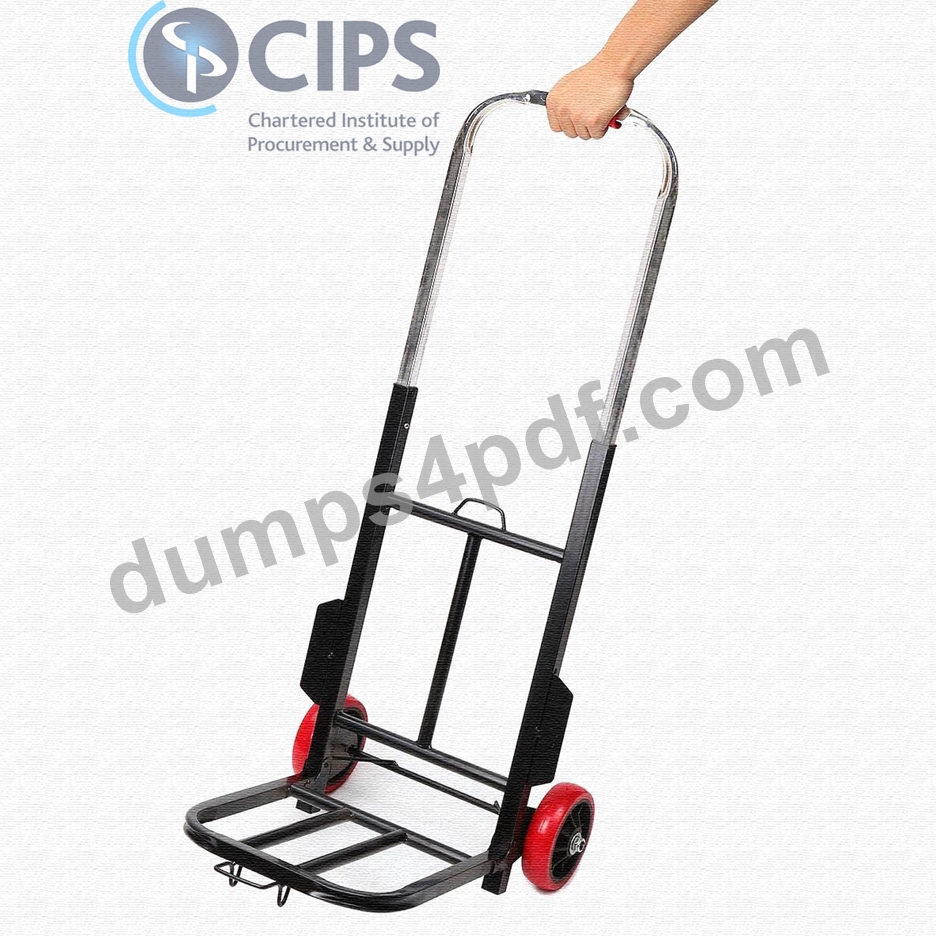
PALLET STACKER is designed to lift and stack pallets. This one is fully mobile so can move easily around the warehouse. An operator would typically sit or stand while driving like a counter-balanced, reach or straddle lift truck.
LO 1, AC 1.3
NEW QUESTION # 115
Using consignment stocking with suppliers can assist with flexible warehousing when space is at a premium in the warehouse. Another advantage of using the consignment stocking approach is that ...
- A. inventory management is easier as the stock belongs to the supplier
- B. the goods do not have to be paid for until the customer uses them
- C. the goods are not produced until the customer places a purchase order
- D. it increases the amount of stock that needs to be held by the customer
Answer: B
Explanation:
With consignment stocking, the supplier retains ownership until the item is used by the customer. This approach minimizes the customer's holding costs and improves cash flow, as payment is deferred until the item is consumed. It's particularly beneficial in whole-life asset management for inventory flexibility and reduced capital commitment.
NEW QUESTION # 116
Do all types of warehouses require access to daylight to reduce the cost of electricity?
- A. No, because only ventilation can help to reduce the humidity in the warehouse
- B. No, because some types of stock are sensitive to sunlight
- C. Yes, because organisation's need for artificial lighting and heating will reduce
- D. Yes, because sunlight sterilises inventories in damp conditions
Answer: B
Explanation:
The design of a building should consider the advantages of natural light as this can reduce the cost of artificial lighting and improve the environmental performance of the building. Daylight entering the building can also help reduce heating costs. Unfortunately some stocks react badly to direct sunlight, and some stock reacts badly to extreme of temperature or may require a specific temperature for storage. Some stock may require a warmer temperature than the ambient temperature and other stocks may require cooler temperature. For example, fabric and garment are sensitive to direct sunlight as ultraviolet light catalyses a reaction between the water present in all fabrics and atmospheric oxygen to create hydrogen peroxide. This is a bleaching agent and breaks down the chemical bonds that give dyes their colour.
Reference:
LO 1, AC 1.1
NEW QUESTION # 117
MRP system is the most suitable IT system to manage which type of items?
- A. Independent demand
- B. Dependent demand
- C. Fast moving components
- D. Construction projects
Answer: B
Explanation:
Material requirement planning (MRP) is a production planning and material (inventory) control system used in manufacturing. Objectives of MRP are to ensure materials are available for production while minimising inventory and to plan production and procurement activities.
Bill of materials (BOM) is an important component of MRP. BOM is also known as product struc-turer. This lists all the items that comprise each assembly and sub-assembly that make up the final product or end item.
Therefore, MRP is commonly used to manage dependent demand stock.
NEW QUESTION # 118
Which of the following are most likely the benefits of using unit loads? Select TWO that apply.
Increase transport time of each item
- A. Reduce handling cost of one unit
- B. Unit loads must be placed on pallets
- C. Safer handling
- D. Minimise space utilisation
Answer: A,C
Explanation:
The concept of a unit load is to create a stable and secure, easy-to-move group of stock that is fast to load and unload from vehicles.
The advantages of unit load concepts are as the following:
* More items can be handled at the same time, thereby reducing the number of trips required and, potentially, reducing handling costs, loading and unloading times, and product damage.
* Enables the use of standardized material handling equipment.
Reference: CIPS study guide page 60-61
LO 1, AC 1.3
NEW QUESTION # 119
Which of the following supply chain activities can distort data for forecasting inventory?
1. Sales promotions by the marketing department
2. Over-ordering by customers
3. Increase in stock movements in the warehouse
4. Volatile logistic and container prices
- A. 1 and 4
- B. 5 and 4
- C. 1 and 2
- D. 2 and 3
Answer: C
NEW QUESTION # 120
Which of the following are typical characteristics of 2D barcodes? Select TWO that apply.
- A. Every 2D barcodes must conform international standards
- B. 2D barcodes can contain more data than 1D barcodes
- C. 2D barcodes can be read by linear scanners
- D. The 2D barcodes are machine-readable
- E. 2D barcodes are exclusively used for marketing purpose
Answer: B,D
Explanation:
Two-dimensional (2D) barcodes look like squares or rectangles that contain many small, individual dots. This has many different types (i.e. Data matrix, QR codes, Aztec code,...) and several different standards in use (i.e. GS1 standards, ISO/IEC 18004:2015). It can be substituted for 1D barcode, but it has the capability to hold a larger amount of data. For examples, GS1 Data Matrix can contain 3116 Numeric characters or 2335 Alphanumeric characters while GS1-128 barcode has maximum capacity of 48 characters.
Like 1D barcodes, 2D barcodes are also machine-readable with dots/squares and spaces. They have symbology like this: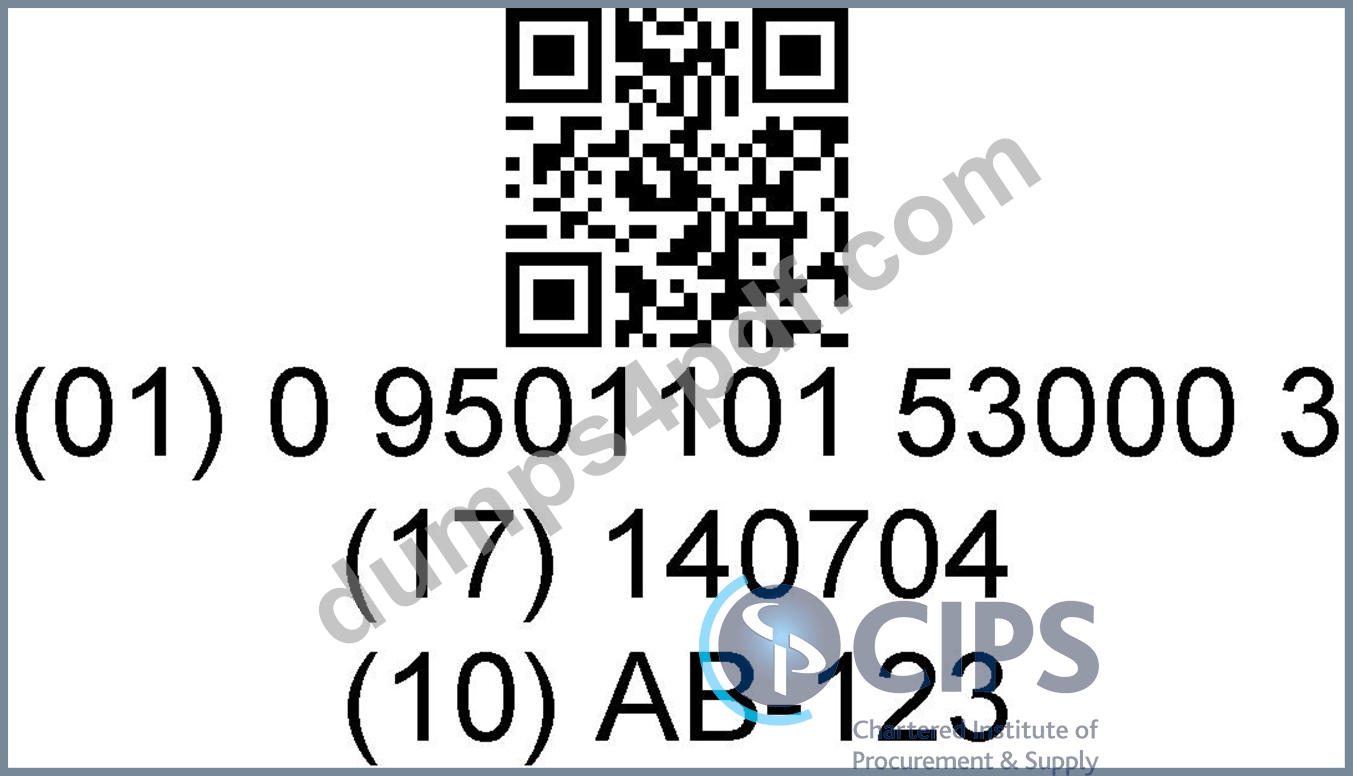
Since the code is two dimensional, conventional laser scanner can't read it. 2D barcodes require imaging scanner to read.
2D barcodes can be also used for different purposes throughout the supply chain: identifying prod-ucts/SKU (single unit, packaged or pallet), identifying content of a purchase order or delivery, identifying the batch number from which the item originates, identifying the manufacturer, country of origin etc, tracking status of an order, shipment or delivery Reference:
LO 1, AC 1.2
NEW QUESTION # 121
When using ABC analysis to classify inventory, which factors must be considered?
1. Demand uncertainty of each item
2. Cumulative percentage of items
3. Cumulative percentage usage value of items
4. Overall inventory turnover
- A. 2 and 3 only
- B. 1 and 4 only
- C. 1 and 3 only
- D. 2 and 4 only
Answer: A
Explanation:
ABC analysis is applied to stock and its management. It is based loosely on the Pareto principles, better known as 80/20 rule. Pareto principle is the theory that 80% of outcome results from 20% of inputs. For example, 80% of sales are to the top 20% of customers; 80% of spend on inventory is accounted for by the top
20% of stock items.
The ABC concept is based on Pareto's law. The following steps are carried out for the ABC analy-sis.
- Step 1: Compute the annual usage value for every item in the sample by multiplying the annual requirements by the cost per unit.
- Step 2: Arrange the items in descending order of the usage value calculated above.
- Step 3: Make a cumulative total of the number of items and the usage value.
- Step 4: Convert the cumulative total of the number of items and usage values into a percentage of their grand totals.
- Step 5: Draw a graph connecting cumulative % items and cumulative % usage value. The graph is divided approximately into three segments, where the curve sharply changes its shape. This indicates the three segments A, B and C.
LO 2, AC 2.1
NEW QUESTION # 122
A brewery sells its beer in aluminum cans. It recycles the cans by using contractors to collect and mold the used cans. This is an example of...?
- A. Carbon recycling
- B. Open-loop recycling
- C. Closed-loop recycling
- D. Reuse
Answer: C
Explanation:
There are two main processes of recycling - open loop recycling and closed loop recycling.
Open Loop Recycling
Open loop recycling is a method that delays disposal by converting manufactured goods and spent materials into both new raw materials, which can be used for a manufacturing purpose, as a fuel source for a different manufacturing process and waste products.
Typically, materials recycled through open-loop recycling will be used for purposes different from their original purpose.
This means that the input into the recycling process is converted to a new raw material, which can be used as an input into another manufacturing process.
Materials in an open loop recycling process are treated using various forms of treatment including heat, chemical reactions, or physical crushing.
Closed Loop Recycling
Closed loop recycling is a process where waste is collected, recycled and then used again to make the same product it came from. This process is restorative and regenerative by design and aims to keep materials at their highest utility and value always.
Closed loop recycling is focused on resource sustainability, which means that recycling of a material can be done indefinitely without degradation of properties. In this case, conversion of the used product back to raw material allows repeated making of the same product, which helps hazardous waste generators reduce carbon footprint and achieve corporate sustainability initiatives.
Closed-loop recycling is common in specialized industries, such as the computer and battery industries, which use expensive or complex goods that cannot easily be broken down post-consumption into constituent materials.
A prime example of a closed-loop recycling process is the recycling of aluminum cans. Aluminum can be recycled to form new cans with little material degradation or waste creation.
NEW QUESTION # 123
When deciding on the storage facilities and locations, an organisation needs to assess the current situation comprehensively and forecast the future demands. Quantitative analysis is the best method for these activities. Is this statement true?
- A. No, some intangible information is difficult to collect and measure
- B. No, subjective judgements are the best as they compensate for weaknesses of quantita-tive analysis
- C. Yes, quantitative analysis is easy to implement as it is based on 'hard' facts
- D. Yes, quantitative analysis provides a reality based on numerical values
Answer: A
Explanation:
Decisions regarding stores and warehouse locations involve a complex range of issues that are unique to each business. Most storage facilities and location decisions are based on a combination of qualitative and quantitative analysis.
Qualitative analysis uses subjective judgment to analyze a situation based on non-quantifiable in-formation, such as potential markets for new products, forecast on possible risks that may happen, etc.
Quantitative analysis (QA) is a technique that uses mathematical and statistical modeling, meas-urement, and research to understand behavior. Quantitative analysts represent a given reality in terms of a numerical value. This may include the following:
- Cost analysis for the current premises and future predictions based on current premises
- Cost analysis for routine operations
- Current inventory performance measures: lead times, service levels, rate of stock turn, stock-outs in a given period and stock cover To get a big picture of current situation and future demands, organisation should combine both qualitative and quantitative methods so that useful information is achieved and well-informed decisions are made.
Reference:
LO 1, AC 1.1
NEW QUESTION # 124
The width of aisles within a warehouse is determined by...?
- A. The length of storage racking
- B. The height of the building
- C. Turning cycle of forklift and the size of pallets
- D. The location of goods-in and goods-out doors
Answer: C
Explanation:
Below is a formula from Toyota you can use to make an informed decision.
1. Start with the basic right-angle stacking width
2. Add the load length
3. Add 12 inches for clearance
The basic right-angle stacking width is the smallest amount of space a forklift needs turn in order to insert its forks into a pallet. You can find basic right-angle stack measurements in the equipment manual or by contacting TMHNC if your business is located in Northern California. This measurement does not include the length of the load or room need for clearance.
Load lengths vary depending on your application, products, etc. As a starting point, a standard pallet has a 48- inch load length. Always check your forklift's data plate for the rated capacity (which is affected by attachments and other factors).
Adding 12 inches for clearance ensures you have enough room for your forklift's turn radius and helps protect against damage from operator error and/or product that may hang over the edge of the pallet.
NEW QUESTION # 125
Hi-Tech Products Inc. (HTP) has just opened a new state-of-the-art distribution centre. It has invested heavily in new technology that will help manage, store, and identify stock items and their locations quickly and continuously. Its investment uses wireless technology. HTP will be using which of the following?
- A. Radio Frequency Identification (RFID)
- B. Handheld scanning devices
- C. ABC classification management
- D. Barcodes
Answer: A
NEW QUESTION # 126
RFID uses radio frequencies for the purpose of identification and tracking of assets. Which of the following are disadvantages of using RFID? Select THREE that apply.
* RFID can be too expensive for many applications compared to other tracking and identification methods
* RFID tags have a limited amount of memory and are less effective than other product tracking systems
* It is difficult for an RFID reader to read the information where tags are installed in liquid or metal products
* Interference has been observed to take place in RFID systems when devices such as hand-held, portable, two-way radios are in use
* RFID provides a much less robust type of security compared to other forms of scanning systems
* RFID is a restriction in managing the updates of stocks during the transportation of products
- A. 3, 5, and 6
- B. 1, 3, and 4
- C. 1, 2, and 5
- D. 2, 4, and 6
Answer: B
Explanation:
RFID technology, while advanced, has several limitations:
* Cost: RFID can be expensive, particularly for smaller operations.
* Reading limitations with certain materials: Liquids and metals can interfere with RFID signals, limiting their effectiveness.
* Interference: Devices such as radios can disrupt RFID systems, reducing reliability.
In whole-life asset management, these disadvantages may affect the decision to implement RFID, especially in cost-sensitive or materials-sensitive applications.
NEW QUESTION # 127
Stockyards are suitable for specific materials with which of the following characteristics? SelectTWOthat apply.
- A. Equipment that requires larger specialised handling
- B. Items that are bulky and individually packed
- C. Small equipment that is of relatively low value
- D. Equipment only suited for inside storage
- E. Equipment with a long delivery lead time
Answer: A,B
NEW QUESTION # 128
Which of the following is a main objective of just-in-time?
- A. Higher safety stock
- B. Leveraging economic order quantity
- C. Better demand forecasting
- D. Waste reduction
Answer: D
Explanation:
JIT, often referred to as the Toyota production system (TPS), originated in Toyota's manufacturing plants in Japan in the early 1970s. It was first introduced by the organisation's owner, Taiichi Ohno. The prime goal of JIT is the achievement of zero inventories.
The just-in-time objectives of eliminating waste can be summarised in the 'five zeros: zero defects, zero set-up times, zero inventories, zero handling and zero lead times.
Reference: CIPS study guide page 122-127
LO 2, AC 2.3
NEW QUESTION # 129
Which of the following is a main objective of just-in-time?
- A. Higher safety stock
- B. Leveraging economic order quantity
- C. Better demand forecasting
- D. Waste reduction
Answer: D
Explanation:
JIT, often referred to as the Toyota production system (TPS), originated in Toyota's manufacturing plants in Japan in the early 1970s. It was first introduced by the organisation's owner, Taiichi Ohno. The prime goal of JIT is the achievement of zero inventories.
The just-in-time objectives of eliminating waste can be summarised in the 'five zeros: zero defects, zero set-up times, zero inventories, zero handling and zero lead times.
Reference:
LO 2, AC 2.3
NEW QUESTION # 130
Which is the best definition of reorder point?
- A. The point at which stock will fall to zero minus lead-time
- B. The point when stock reaches zero
- C. The point when one unit of stock remains in stock
- D. The level inventory at which an order must be made
Answer: D
Explanation:
Reorder point is the point either in time or in a process when the next order should be placed.
Reference:
LO 2, AC 2.3
NEW QUESTION # 131
Which of the following best describes available inventory (also known as inventory position)?
- A. The amount of inventory on hand
- B. The amount of inventory on hand plus the amount of inventory on order
- C. The amount of inventory on order only
- D. The amount of inventory on hand in excess of expected demand
Answer: B
Explanation:
Available inventory (or Inventory position - IP) is equal to inventory on-hand plus quantity on order minus backorder (if any) Reference: CIPS study guide page 117 LO 2, AC 2.3
NEW QUESTION # 132
Which of the following factors will need to be taken in to account when deciding on the location of a warehouse?
- A. Duration of lease or freehold of the property
- B. Cost of land, rent and rates
- C. Internal design and layout of the warehouse
- D. Proximity to local amenities and fast food outlets
Answer: B
NEW QUESTION # 133
......
CIPS L4M7 exam is an essential qualification for procurement professionals who are looking to specialize in asset management. L4M7 exam covers a wide range of topics, including asset identification, valuation, maintenance, and disposal. It is designed to help candidates develop the skills and knowledge necessary to effectively manage assets and ensure their long-term value. Successful completion of the exam is an important step in advancing one's career in asset management.
Fully Updated Dumps PDF - Latest L4M7 Exam Questions and Answers: https://www.dumps4pdf.com/L4M7-valid-braindumps.html
100% Free L4M7 Exam Dumps to Pass Exam Easily: https://drive.google.com/open?id=1L2sclGt69wD39nTyWjL32ONP_VPhSaU5