


Verified PDII Dumps Q&As - PDII Test Engine with Correct Answers
Pass Your PDII Dumps as PDF Updated on 2025 With 204 Questions
Salesforce Certified Platform Developer II (PDII) is a highly valued certification that validates the skills and knowledge of experienced Salesforce developers. Salesforce Certified Platform Developer II (PDII) certification is designed for professionals who have already earned the Salesforce Certified Platform Developer I credential and are looking to further advance their careers in this field. The PDII exam tests the developers’ expertise in developing advanced customizations using Apex and Visualforce, as well as their ability to design and deploy complex business logic and security models.
The PDII certification exam consists of multiple-choice questions and hands-on exercises that test a developer's ability to solve real-world problems using Salesforce. Developers must complete a programming assignment that demonstrates their ability to create a custom application on the Salesforce platform. PDII exam also covers topics such as data modeling, security, and integration.
Salesforce PDII (Salesforce Certified Platform Developer II) certification is designed for the developers who have experience in building custom applications and analytics using the Salesforce platform. It is the next level certification for the Salesforce Certified Platform Developer I (PD1) certification. The PDII certification exam validates the developer's knowledge and expertise in designing and developing advanced custom applications using Apex and Visualforce.
NEW QUESTION # 53
Assuming the CreateOneAccount class creates one account and implements the Queueable interface, which syntax properly tests the Apex code?
- A.
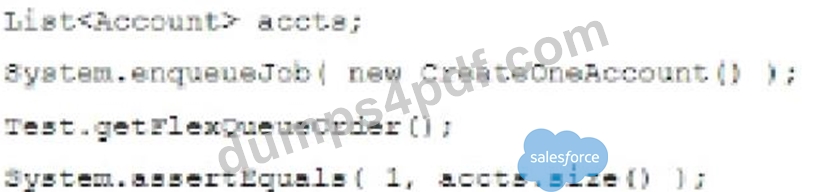
- B.
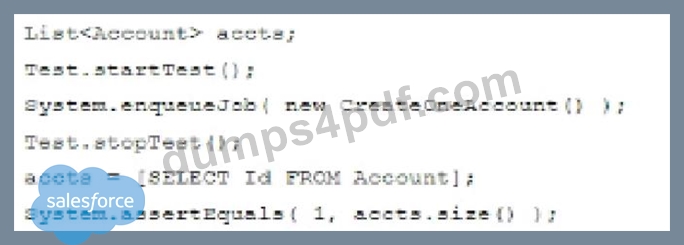
- C.
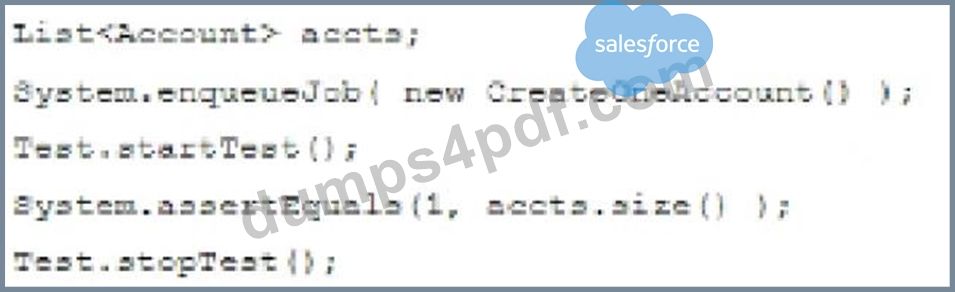
- D.
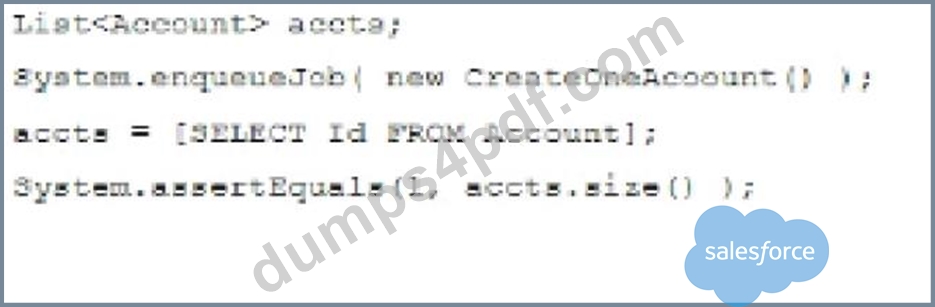
Answer: B
NEW QUESTION # 54
A developer wants to write a generic Apex method that will compare the Salesforce Name field between any two object records. For example, to compare the Name field of an Account and an Opportunity; or the Name of an Account and a Contact.
Assuming the Name field exists, how should the developer do this?
- A. Use a string. Replace () method to parse the contents of each Name field and then compare the results.
- B. describe) function to compare the values of each Name field.
- C. Use the Salesforce Metadata API to extract the value of each object and compare the Name fields.
- D. Cast each object into an sObject and use sObject.get to compare the Name fields,
Answer: D
Explanation:
Casting each object to an sObject and using the get method to compare the Name fields is the correct approach. This is because sObjects are generic object representations that can be used to access the fields of any Salesforce object dynamically. References:
sObject Class
NEW QUESTION # 55
What is the correct way to fix this?
- A. Add Test_startTest() before and add Test. stopTest() after Line 18 of the code.
- B. Add Test.startTest() before and add Test. stopTest() after both Line 7 and Line 20 of the code.
- C. Use Limits.getlimitQueries() to find the total number of queries that can be issued.
- D. Change the DataFactory class to create fewer Accounts so that the number of queries in the trigger is reduced.
Answer: A
Explanation:
The correct way to fix the test method is to add Test.startTest() before and add Test.stopTest() after Line 18 of the code. Test.startTest() and Test.stopTest() are methods that mark the start and the end of the test code and ensure that all asynchronous processes are completed before the test method finishes. This way, the developer can verify that the batch job is executed and the Account records are updated as expected. The developer should also use the System.assertEquals() method to assert the expected and actual values, instead of System.debug() which only prints the values to the debug log . Reference: [Testing Asynchronous Apex], [Test.startTest()], [System.assertEquals()]
NEW QUESTION # 56
Which two best practices should the developer implement to optimize this code? Choose 2 answers
- A. Change the trigger context to after update, after insert
- B. Query the Driving-Structure_C records outside of the loop
- C. Use a collection for the DML statement.
- D. Remove the DML statement.
Answer: B,C
Explanation:
To optimize the code in question, it's important to follow best practices that reduce the number of SOQL queries and DML statements within loops, as these can quickly consume governor limits and lead to inefficiencies. Option C is correct because using a collection to hold records and performing a single DML operation outside of loops reduces the number of DML operations, which is a best practice for bulkifying code in Salesforce. Option D is also correct because querying records outside of a loop prevents hitting SOQL governor limits and makes the code more efficient. Options A and B are not correct in the context provided, as there isn't enough information to determine if changing the trigger context is necessary, and removing the DML statement altogether may not be feasible if the logic requires data to be persisted.
References
Apex Best Practices: Apex Developer Guide Best Practices
NEW QUESTION # 57
A developer wrote the following method to find all the test accounts in the org: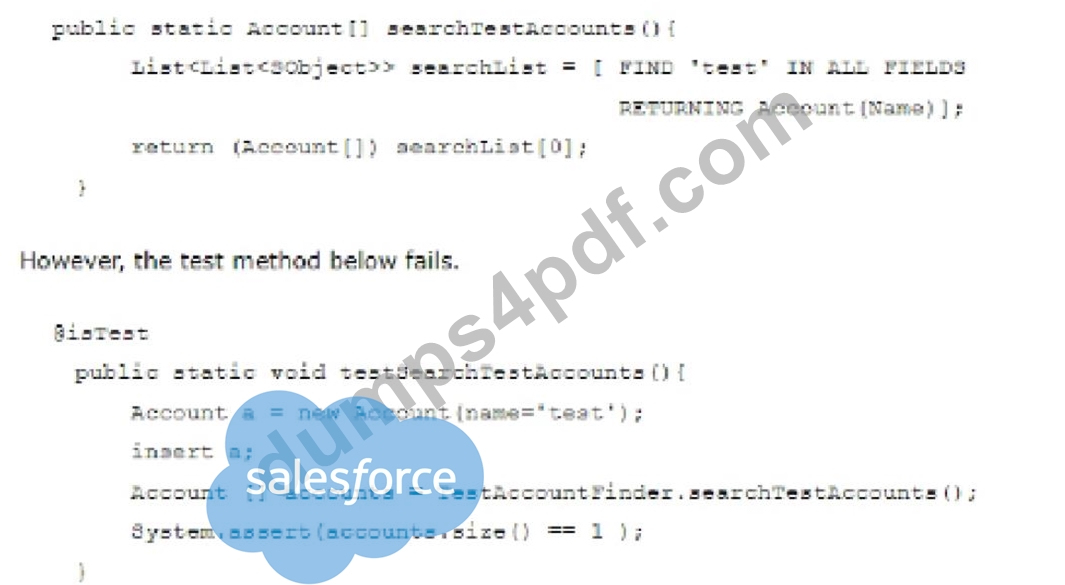
What should be used to fix this failing test?
- A. @isTest (SeeAllData=true) to access org data for the test
- B. @testsetup method to set up expected data
- C. Teat.loadData to set up expected data
- D. Test. fixsdSsarchReaulta [) method to set up expected data
Answer: D
NEW QUESTION # 58
Which interface needs to be implemented by a Lightning Component so that it may be displayed in modal dialog by clicking a button on a Lightning Record page?
- A. Lightning:editAction
- B. Force:lightningEditAction
- C. Fightning:quickAction
- D. Force: lightningQuickAction
Answer: C
NEW QUESTION # 59
What are three benefits of using static resources in Visualforce and Lightning Components? (Choose three.)
- A. Static resource files do not count against an organization's quota of data storage.
- B. Static resource files can be packaged into a collection of related files in a zip or jar archive.
- C. Static resource files are automatically minified.
- D. Relative paths can be used in files in static resource archives to refer to other content within the archive.
- E. Static resource files can be referenced by using the $Resource global variable instead of hardcoded IDs.
Answer: B,D,E
NEW QUESTION # 60
Code must have X% overall code coverage.
- A. X = 65
- B. X = 50
- C. X = 100
- D. X = 75
Answer: D
Explanation:
Explanation
Explanation:
All triggers must have at least 1% code coverage
NEW QUESTION # 61
An Apex trigger creates an Order__c record every time an Opportunity is won by a Sales Rep. Recently the trigger is creating two orders. What is the optimal method for a developer to troubleshoot this?
- A. add system.debug() statements to the code and use the Developer Console logs to trace the code.
- B. Set up debug logging for every Sales Rep, then monitor the logs for errors and exceptions.
- C. Run the Apex Test Classes for the Apex trigger to ensure the code still has sufficient code coverage.
- D. Turn off all Workflow Rules, then turn them on one at at time to see which one causes the error.
Answer: D
NEW QUESTION # 62
A developer is asked to replace the standard Case creation screen with a custom screen that takes users through a wizard before creating the Case. The org only has users running Lightning Experience.
What should the developer override the Case New Action with to satisfy the requirements?
- A. Lightning Page
- B. Lightning Component
- C. Lightning Flow
- D. Lightning Record Page
Answer: C
Explanation:
Overriding the standard Case New Action with a Lightning Flow allows the developer to create a custom wizard-style interface for creating cases. Lightning Flows can be embedded in Lightning Experience and provide a guided visual experience.
References:
Lightning Flow
NEW QUESTION # 63
Which statement is true regarding savepoints?
- A. You can roll back to any savepoint variable created In any order
- B. Savepoints are not limited by DML statement governor limits
- C. Static variables are not reverted during a rollback.
- D. Reference to savepoints can cross trigger invocations.
Answer: A
NEW QUESTION # 64
Consider the following code snippet: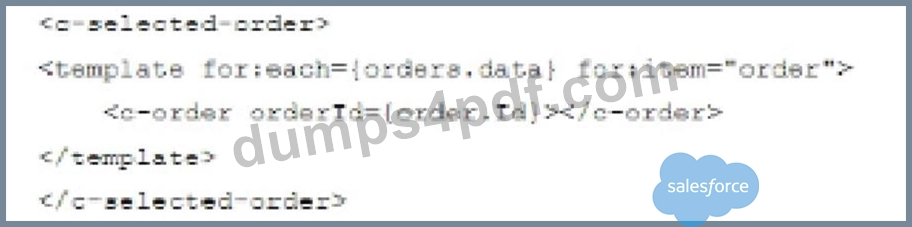
How should the <e-orders> component communicate to the <c-selected-orders component that an order has been selected by the user?
- A. Create and fire an application event.
- B. Create and fire a standard DOM event.
- C. Create and dispatch a custom event,
- D. Create and fire a component event.
Answer: C
Explanation:
Custom events are events that can be created and dispatched by the developer using the CustomEvent constructor and the dispatchEvent method. Custom events can be used to communicate between components that are in the same DOM tree, such as parent and child components. By creating and dispatching a custom event from the <e-orders> component, the developer can pass the selected order information to the <c-selected-orders> component, which can listen for the event using the @wire or @track decorator and handle the event accordingly. Custom events are more efficient and flexible than component or application events, which are deprecated in Lightning web components. Reference: [Custom Events], [Communicate with Events]
NEW QUESTION # 65 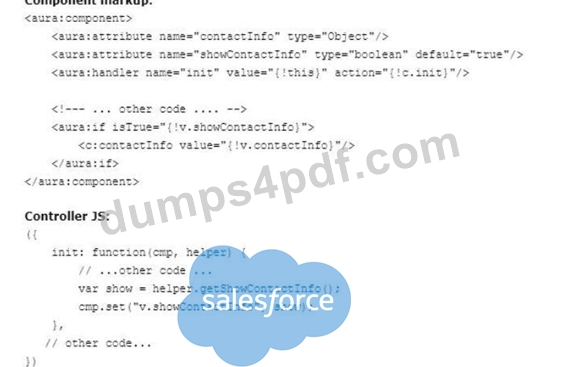
A developer receives complaints that the component loads slowly.
Which change can the developer implement to make the component perform faster?
- A. Change the type of contactlnfo to "Map".
- B. Change the default for showContacrlnfo to
- C. Add a change event handler for showContactinfo
- D. Move the contents of <c: concacclnfo into the component.
Answer: B
NEW QUESTION # 66
Which Salesforce feature allows a developer to see when a user last logged in to Salesforce if real-time notification is not required?
- A. Asynchronous Data Capture Events
- B. Calendar Events
- C. Developer Log
- D. Event Monitoring Log
Answer: D
Explanation:
The Event Monitoring Log is the best feature to use to see when a user last logged in to Salesforce if real-time notification is not required. The Event Monitoring Log provides detailed information about various events that occur in the org, such as logins, API calls, report exports, etc. The developer can query the LoginEvent object to get the timestamp, username, and other details of the login events. The Calendar Events, Asynchronous Data Capture Events, and Developer Log are not relevant for this scenario, as they do not capture the login information of the users. Reference: [Event Monitoring], [LoginEvent]
NEW QUESTION # 67
Users report that a button on a custom Lightning web component (LWC) is not saving the data they enter. The button looks to be clicked, but the LWC simply sits there, seemingly doing nothing.
What should the developer use to ensure error messages are properly displayed?
- A. Add JavaScript and HTML to display an error message.
- B. Use the Database method with a110rNone Set to false.
- C. Add the <apex:messages/> tag to the component.
- D. Add a try-catch block surrounding the DML statement.
Answer: A
Explanation:
To ensure error messages are properly displayed in a Lightning web component, the developer should use JavaScript to handle errors in the component's client-side code and use HTML to display the message on the UI. This can be combined with Apex exception handling for server-side operations.References: Lightning Web Components Developer Guide - Error Handling
NEW QUESTION # 68
When the sales team views an individual customer record, they need to see recent interactions for the customer. These interactions can be sales orders, phone calls, or Cases. The date range for recent interactions will be different for every customer record type.
How can this be accomplished?
- A. Use a dynamic form on the customer record page to display recent interactions.
- B. Use a Lightning component to query and display interactions based on record type that is passed in using a design:attribute from the Lightning page.
- C. Use Lightning Flow to read the customer's record type, and then do a dynamic query for recent interactions and display on the View page.
- D. Use batch Apex to query for the most recent interactions when the customer view screen is loaded.
Answer: B
Explanation:
The best way to accomplish this requirement is to use a Lightning component to query and display interactions based on record type that is passed in using a design:attribute from the Lightning page. A Lightning component is a reusable unit of an app that can include markup, JavaScript, CSS, and Apex. A Lightning component can use the Lightning Data Service or Apex to query data from Salesforce and display it on a Lightning page. A design:attribute is a way to define attributes for a Lightning component that can be set in Lightning App Builder or Experience Builder. By using a Lightning component, the developer can create a custom UI element that can query and display the recent interactions for the customer based on the record type that is passed in as a design:attribute from the Lightning page. This way, the developer can leverage the Lightning framework and the Lightning Data Service or Apex to create a dynamic and interactive component that meets the requirement. Reference: [Lightning Components Basics], [Lightning Data Service Basics], [Design Attributes in Aura Components], [Design Attributes in Lightning Web Components]
NEW QUESTION # 69
A developer implemented a custom data table in a Lightning web component with filter functionality.
However, users are submitting support tickets about long load times when the filters are changed. The component uses an Apex method that is called to query for records based on the selected filters.
What should the developer do to improve performance of the component?
- A. Use a selective SOQL query with a custom Index.
- B. Use setstoraclel() in the Apex method to store the response In the client-side cache.
- C. Return all records into a list when the component is created and filter the array In JavaScript.
- D. Use SOSL to query the records on filter change.
Answer: A
Explanation:
When faced with performance issues in a Lightning Web Component (LWC) due to SOQL query load times, the optimal approach is often to improve the query's selectivity. This can be achieved by using a selective SOQL query with a custom index. Salesforce can create custom indexes to improve the performance of queries that cannot be optimized through standard indexing. When a query is selective, it can efficiently retrieve records from the database using the index, thus reducing the query execution time and speeding up the component's performance when filters are changed. The other options (returning all records, using SOSL, or client-side caching) do not directly address the root cause of the performance issue, which is the need for a more efficient database operation.
References:
Make SOQL Query Selective
Use of Indexes in SOQL Queries
NEW QUESTION # 70
A developer created a JavaScript library that simplifies the development of repetitive tasks and features and uploaded the library as a static resource called rsutils in Salesforce. Another developer is coding a new Lightning web component (LWC) and wants to leverage the library, Which statement properly loads the static resource within the LWC?
- A. impore {jsUtilities} from
- B. <lightning-require scripts="{|$Resource,jaUtils}"/>
- C. const jsUtilivy = SA.get{'SResource.isUtils');
- D. import jsUtilities from '@salesforce/rescurceUr1/jaUtiles';
Answer: D
Explanation:
'@salasforce/resourceUrl/jsUtils';
Explanation:
The correct statement to load the static resource within the LWC is import jsUtilities from '@salesforce/resourceUrl/jsUtils'. This statement imports the URL of the static resource named jsUtils and assigns it to the jsUtilities variable. The developer can then use the jsUtilities variable to reference the JavaScript library in the LWC template or script. The developer can also use the loadScript() method from the lightning/platformResourceLoader module to load the JavaScript library dynamically . Reference: [Importing Static Resources], [lightning/platformResourceLoader Module]
NEW QUESTION # 71
Exhibit.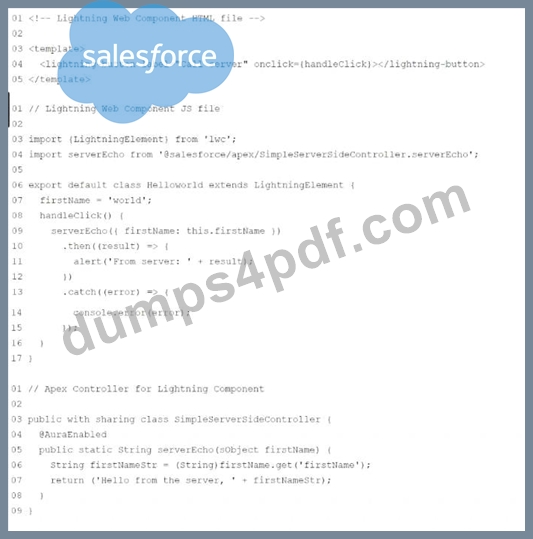
Given the code above, which two changes need to be made in the Apex Controller for the code to work?
Choose 2 answers
- A. Change the method signature to be global static, not public to String.
- B. Change the argument in the Apex Controller line 05 from subject to string.
- C. Annotate the entire class as @AuraEnabled instead of just the single method.
- D. Remove line 06 from the Apex Controller and instead use firstName in the return on line 07.
Answer: B,D
Explanation:
Based on the code provided, here are the necessary changes:
Change B is required because the argument in the Apex controller's serverEcho method must match the data type expected by the JavaScript calling the method. The Apex method expects an Object named firstName, which is then cast to a String inside the method. The JavaScript is passing an object with a property firstName, so no change is needed in the JavaScript.
Change D is correct because line 06 is redundant and unnecessary. We can directly use firstName in the return statement as it is already a String type. The get() method is typically used when you have a Map and you need to retrieve a value by its key. Since firstName is already being passed as a String, there's no need to cast it or retrieve it using get().
References:
Apex Developer Guide
NEW QUESTION # 72
......
Pass Salesforce PDII Exam Info and Free Practice Test: https://www.dumps4pdf.com/PDII-valid-braindumps.html
Salesforce PDII Real Exam Questions and Answers FREE: https://drive.google.com/open?id=1_vuGC5bIxUWLQfrsutiojr2ZFHSFefOl